Recent Content
Help identifying XML fields for message attributes in Khoros data export
I'm working on a project where I need to parse and process a Khoros XML data export of my community, and I'm trying to map out the right entities and fields for several message-level attributes. Specifically, I'm trying to figure out which XML files, entities, and fields correspond to the following: Visibility scope of a message i.e how can I tell a message is private, draft or archived Whether the message is a solution and solution is marked by which user / user_id and when (time) Whether the message is read only or has comments blocked Moderation status - whether the message was rejected, approved etc Kudos - How can I find the kudos count and individual kudo for a message e.g user, time and weight info similarly, where is the MeToo data stored for a message? Any help with field names, entity references, look in would be a huge help.19Views0likes1CommentHelp identifying XML fields for message attributes in Khoros data export
I'm working on a project where I need to parse and process a Khoros XML data export of my community, and I'm trying to map out the right entities and fields for several message-level attributes. Specifically, I'm trying to figure out which XML files, entities, and fields correspond to the following: Visibility scope of a message i.e how can I tell a message is private, draft or archived (API Reference) Whether the message is a solution and solution is marked by which user / user_id and when (time) (API Reference) Whether the message is read only or has comments blocked (API Reference) Moderation status - whether the message was rejected, approved etc (API Reference) Kudos - How can I find the kudos count and individual kudo for a message e.g user, time and weight info (API Reference) similarly, where is the MeToo data stored for a message? (API Reference) Any help with field names, entity references, look in would be a huge help.Which entity to refer for knowing user to badge mapping in XML data dump
I'm working with XML data dump of my community and I'm able to access users and badge data individually. However, I'm unable to parse user to badge mapping i.e what all badges a specific user has been assigned Which entity or relation I should look for in the XML data dump to get that mapping or help me with any XML data dump related documentation if any55Views0likes1CommentHow to parse <li-answer> <li-table> custom li tags into raw html
I was playing around with XML data dump of messages, and found custom HTML tags (<li-{type}> in the message content. From Khoros API (LiQL), I'm getting transformed HTML content, without any custom lithium HTML tags Tags example - li-answer, li-code, li-emoji, li-code, li-video, li-image etc How to parse such tags, and get content HTML like it is provided in the API using LiQL ?How to determine if a given node is visible to the public?
Hello! I am trying to figure out if it's possible, via API, to determine if a given node is visible to the public. E.g. is the "read posts" permission granted by default on that node. (which I suppose isn't a FULL check of the whole permissions tree but probably adequate for our needs) I've found that the roles collection will give you the list of roles for the node (https://developer.khoros.com/khoroscommunitydevdocs/docs/role-api-support#roles-collection-constraint-combinations ) - but that isn't actually helpful for figuring out what the permissions are, especially the DEFAULT permissions. I've also found the coreNode.permissions.hasPermission (https://developer.khoros.com/khoroscommunitydevdocs/reference/permissionshaspermissionpermission_identifier) call - but I think this can only be used to check if the user in context has a specific permission, not whether or not a node has a certain default permission. (I'm not actually a developer / won't be the one developing this, just trying to determine if a specific enhancement request is possible :-)) Thanks!!Solved1.5KViews2likes7CommentsSubscriptions to a label?
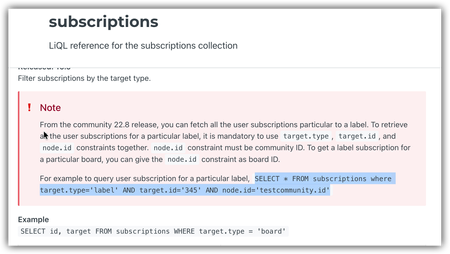
Hi all, I'm attempting to get the list of people who have subscribed to a label, but am struggling. The documentation is a bit confusing: It says both that you have to use a community ID as the node.id constraint but also that you can give the node.id constraint as a board id? Seems conflicting. And, regardless of the documentation, I get an error when I try to use a board ID (such as node.id='board:wireless-lan' where wireless-lan is the id of the board) My user has full admin permissions. Any ideas? I am not really a developer (as is probably evident!), just trying to pull a few bits of data for a stakeholder. Thanks!SolvedWhat Does It Take to Develop a High-Performance Candy AI Clone?
Developing a high-performance candy ai clone requires a scalable architecture, advanced AI integration, and optimized real-time communication systems. The foundation begins with selecting a strong backend such as Node.js or Python (FastAPI) to handle API requests and AI processing. Large Language Models (LLMs) power conversational intelligence, while vector databases like Pinecone store contextual memory for personalized responses. Cloud infrastructure (AWS or GCP) with GPU support ensures smooth AI inference under heavy traffic. Real-time messaging can be implemented using WebSockets: const WebSocket = require('ws'); const wss = new WebSocket.Server({ port: 8080 }); wss.on('connection', ws => { ws.on('message', message => { const aiResponse = processAI(message); ws.send(aiResponse); }); }); Efficient caching with Redis reduces latency, while secure authentication (JWT, OAuth 2.0) protects user sessions. Performance monitoring tools track system health and auto-scale resources dynamically, ensuring consistent speed and reliability.103Views0likes0CommentsliqlAdmin in khoros aurora graphql API
Hi Folks, I want to add roles to the users using graphQL API given below. const ADD_USER_ROLE_MUTATION = gql` mutation addUsersToRole($roleKey: RoleKeyInput!, $users: [UserIdInput!]!) { addUsersToRole(roleKey: $roleKey, users: $users) { result { id name } } } `; const [addUserRole] = useMutation(ADD_USER_ROLE_MUTATION); addUserRole({ variables: { roleKey: { roleName: "role" }, users: [{ id: userId }] } }); The issue I am facing is that when this mutation is executed by an Admin user, the role is successfully added to the target user. However, when the same mutation is executed by a normal user, it fails to add the role due to permission denied errors. Is there a parameter or keyword that can be used in this mutation to allow a normal user to update their own roles or self-related data? For example, in Khoros Classic, we can use the liqlAdmin keyword in REST API requests to bypass such permissions. Is there an equivalent for GraphQL in Khoros Aurora? Thanks in Advance.Solved2.3KViews0likes13CommentsExperience Survey GraphQL
in the graphQL for pulling the experience survey its says the graphQL is: query MyQuery { valueSurveyResponses { csv } } this implies this pulls all survey responses ever, I am wondering if there are constraints or pagination because this could very quickly become a massive dayaset.665Views0likes4Comments
Featured Places
Release Notes & Updates
Review release notes and updates for all of our products! Select a tag to browse by product or resource type.Help & Support
Find solutions and support for Khoros productsSupport Information
Review general information about Khoros Support
Events & Webinars
Learn more about your Khoros solution with helpful webinars and special events
Events
No events to show