Spotify: The Journey to Total Community
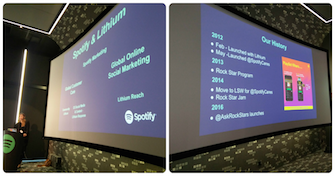
Will the worst snowstorm Sweden has experienced in 10 years stop a community manager from attending a knowledge-sharing and networking event? The answer is no, never! Especially if this event is organised at Spotify’s (amazing) headquarters in Stockholm. This event, aptly named Spotify: The Journey to Total Community was an opportunity for the Spotify Community team ( PerBonomi, Meredith, and Rorey) to tell the story around their community. Its growth, development and the impact it has within Spotify as a whole. During her hour-long mainstage presentation, Meredith took us through the key highlights and initiatives they have launched throughout the past 4 years: The Rock Star Program The move to responsive Expanding the conversation to include Music Chat Idea Exchange and the impact it has on the product The Rock Star Program Launched in 2013, Spotify’s Rock Star Program is a cornerstone to their overall community strategy. Through the years, the program has not only grown to over 150 members, it has also expanded to include initiatives such as the Rock Star Jam as well as their points based rewards scheme. This scheme is aimed at giving the Rock Stars the opportunities to pick tangible rewards based on their contributions within the community and on Twitter. The magic of this, is that it’s still all lives within the community platform thanks to PerBonomi custom component wizarding skills. To discover more about some of the customisations the teams have built with this new design, as well as get some insight on how Virgin Media went responsive last year, check-out the breakout slides here. Music Chat At launch, the main focus of the community was support. And whereas there has always been a place for people to talk about music - it didn’t have a major share-of-voice within the discussions. This is something that the community team decided to change alongside the new design, as they firmly believed that if people came to talk about something that they were passionate about (music), then they would be more likely to stay and support peers. And they were right, it worked. Cherry on top? It had a positive impact on search results too! When looking at 100 users in Music Chat 55% have asked a support question in the Community (100 users sampled) 38% of those 100 users have helped someone answer a question. 70% of those 100 came to the Music area first. Rock Stars and team members alike now all contribute in creating some passion-driven content on the community and its blog. This is something that Sky has recently been doing on their support community too - despite being a support community originally, the community has been evolving to host and nurture passion-driven conversations as well: from entertainment to tech-gurus talking about more than just issues. Check ou… 8.8KViewsSign in to react to this post
 3Comments
New Khoros Community: Splunk
*This post is part of a new series highlighting communities both established, and brand new to the Khoros platform. Subscribe to the "Customer Stories” label to be notified when a new post is added to this series.* The following responses were provided by Bryan Jennewein (bjennewein), Director of Community Engagement at Splunk: Please share a bit of history/background about the Splunk Community. The Splunk Community first launched nearly eleven years ago and today over 12,000 monthly active members visit our site to engage, learn, answer questions, and give back! Most prominent among our community programs has been our Splunk Answers program, which is a community-driven online forum where members can ask questions and get answers about Splunk’s specific products, capabilities, best practices, etc. In addition, our community has grown to include programs for our MVPs (SplunkTrust), local groups (Splunk User Groups), and product feedback (Splunk Ideas). Why did you choose to migrate to the Khoros Community platform? With the growth of our community, our company, and the breadth of helpful content available, we knew that it was time to invest in updates to support our incredibly passionate users and welcome new members with open arms. We wanted to create a central hub for all of our community programs to intersect, and we wanted to grow our existing programs, like Splunk Answers, while also launching brand new programs and new community features. In short, we want to help our entire community connect, collaborate, and share knowledge in every exciting way we can. Khoros, for us, represents our investment in bringing our entire community the technologies and capabilities to enhance their experiences and grow the support, education, and connection (and fun!) our community engagement programs provide. The ability to both migrate our existing programs to Khoros and launch our new programs on Khoros was key in our decision. We needed a platform that could provide the diversity of interaction styles we wanted with the ability to scale and grow as fast as we have been. We chose to migrate to the Khoros Community platform because of its rich features and capabilities, the ability to migrate our product Q&A forum, and the ability to launch new discussions, new content capabilities, and gamification elements, while quickly linking to our User Group and Idea programs. What was most important to you and your Community team during the launch project? Several important factors guided our project, and most important among them was not only preserving but also enhancing our community members’ experience while we executed a major migration from our legacy platform over to Khoros. More than 100k questions, more than 140k answers, millions of comments, and more than 12k users is… A LOT… of content to move. In addition, we wanted to usher in a brand new intuitive user experience that was consistent with…1.9KViewsSign in to react to this post0CommentsWebinar Recap: Community Engagement with Cloudera and The Community Roundtable
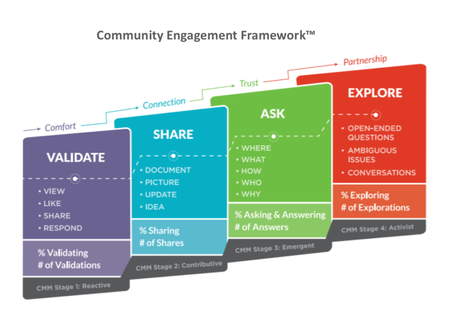
This webinar was an hour that was absolutely packed with great information, frameworks, and anecdotes to understand and implement better engagement strategies. What is Engagement? Engagement is the set of actions that people take to solve problems. Specifically, in an online community, engagement is the set of actions that create value for members. It’s hard to directly measure problems solved and customer happiness, so engagement is the key proxy metric that we all use to measure the value of our communities. That can mean a lot of things, so Rachel and the Community Roundtable team created a framework to help organize the subject. Engagement is also empowering! People engage when they feel safe and confident. When they put themselves out there, receive positive feedback, and connect with peers they are more likely to help engage with and empower others - creating a virtuous cycle of positive value. Engagement is Contextual “If you brought alcohol to work that would be frowned upon, and if you discussed spreadsheets at a dinner party, that would also make you the party pooper. ” - Rachel Happe Determining what kinds of engagement you want to increase and measure really depends on what kind of community you want to build. If you are driving for customer support like Cloudera, then you are probably looking for Ask and Validate activities. If you are building an advocacy program, then you definitely want Share and Explore activities. What is the impact? This is the bulk of the webinar, so I can’t really do it justice in this blog post. Suffice it to say that Engagement usually has a pretty definable ROI in terms of cost avoidance or value created. For example, every support question answered corresponds to some level of case/ticket/call deflection - which has direct monetary costs for a business. Other types of engagement like new ideas, peer connections, and other posts also have value. I heard another community manager once talk about how they assigned value for blogs posted in a community by comparing it to how much they would pay a freelance writer to create a blog on their website (between $100 and $500). How to Measure This was my favorite section, but I am a bit of a numbers geek (it’s the Minor in Math I got in college). Claire and the team at Cloudera are data-driven, and they have one of the most sophisticated and intelligent reporting programs out there. However, the details she gives about response times and engagement across the segments of her community (prospects, customers, partners, and employees) are a gold mine for anyone looking to deliver reports to their executive stakeholders that will earn them a promotion and grow their community support. Watch it now for yourself! Or if you are more of a reader - you can get the full eBook on …1.5KViewsSign in to react to this post0CommentsNew Khoros Community: Visible
*This post is part of a new series highlighting communities both established, and brand new to the Khoros platform. Subscribe to the "Customer Stories” label to be notified when a new post is added to this series.* The following responses were provided by Michelle Ferrall, Principal Product Manager at Visible: Please share a bit of history/background about the Visible Community. We wanted a place for our members to connect with each other. We have groups on other social platforms but didn’t have our own hosted community until we launched with Khoros. One of our top product features is Party Pay, where members can link up with others to get a discount on their wireless service. The Visible Community provides a place within our website for members to join together and get a discount. Why did you choose to launch on the Khoros Community platform? Visible wanted to build a platform that could quickly grow and adapt as we expand our business offerings. We needed something that could be stood up quickly. What was most important to you and your Community team during the launch project? Meeting our launch deadline - we launched the Community in less than one month. What’s next? We’re looking at creating groups to support various initiatives, utilizing the events capability, and getting feedback from members on our product offerings. Goals: Divert care volume Grow Visible member base Foster connections between members Get product feedback from members Community features live today: Forums Blog Ranks Badges Leaderboards Visible Community Team: Michelle Ferrall, Principal Product Manager and Community Manager Kirsten Williams, Business Operations Analyst and Moderation Manager Khoros Team & Contributors: Launch Project Manager: Chris Mayes Senior Community Strategist: Jenny Weigle Senior Front End Developer: Jesse Keyes Front End Developer: Jeanine Schoessler Application Engineer: Thomas Su Customer Success Director: Michelle Ziadie Customer Account Executive: Ken Ban Technical Account Manager: Kaleena Perkins Atlas users, please take a moment to check out the Visible Community! Reply and let us know what you like best about it!825ViewsSign in to react to this post0Comments


You’ve seen all recent content