POV: Is there room for brands on Clubhouse?
Clubhouse App POV Is there room for brands on the hottest social media app? It’s a fact: everyone is talking about Clubhouse and chances are you’ve probably been invited by someone you know. In January and February of this year alone, there were 5.9 million mentions of Clubhouse on Twitter (667% growth in comparison to the previous 2 months) as people have been flocking to the app in the name of FOMO (Source: Khoros Intelligence). But what exactly is Clubhouse and how does it work? More importantly, should brands activate on the platform? With the app’s rapid rise to popularity during late 2020, brands are quietly scrambling to learn more about it and trying to figure out how to navigate the emerging platform from a marketing/PR perspective. We hope this POV helps brands better understand the app and gives social media teams the information needed to determine if Clubhouse is right for them. Clubhouse at a Glance Audio-Only: This is the biggest element that differentiates Clubhouse from other social media platforms. As an audio-only based application, you can't share pictures, videos, or even text. All you can do is talk. The app has heavily capitalized on leveraging the use of sound and minimizing visual elements. As our CMO Katherine Calvert stated in an interview with CMSWire, “Clubhouse is the anti-Zoom,” which is quite refreshing for the many who are experiencing screen fatigue this year. Invite-Only: Currently, you need to be invited by someone to create a Clubhouse account. This approach has been a large factor in propelling the app’s popularity forward. It is perceived as exclusive and people around the world have fear of missing out (understandably so). iPhone-Only: The Clubhouse app is currently only available via the Apple App Store (sorry, Android users). However, in a January 2021 press release, the company announced their intent to begin working on an Android app “soon.” They better hurry: the latest data shows that Android devices make up more than 70% of the mobile market share worldwide, compared to less than 30% for iPhones. In the United States, however, iPhones account for 60% of the mobile market share, with Android lagging at 39%. So, How does Clubhouse Work? The Largest Virtual Conference in the World: Clubhouse can be described as a huge virtual conference about every single topic you can imagine. When you enter a room, the audio switches on and you can hear people speaking — it’s like walking into a conference room where a panel or Q&A is happening. The room’s creator can decide who gets to speak. Users can create and join "rooms" where you can chat with others about topics like dog grooming, starting a small business, and even getting a divorce. There is a large focus on high-value conversations: Say goodbye to produced/precomposed content. Clubhouse is fueled by real-time, highly engaging conversations where everyone who speaks brings value to the conversation. This culture has generated a loyal user base who adheres to and fosters an environment of quality conversations. A Hallway with Endless Rooms: The Hallway is what Clubhouse calls its main feed. This is where you’ll find active rooms and panels. Think of it as walking down a hallway at Comic-Con, SXSW, or any other conference. Brands Using Clubhouse In a Clubhouse Townhall on 2/28, the company shared that they don’t want brands making accounts; instead, they’d prefer brands make clubs* in order to maintain the identity-based culture of the platform. That said, here are a few brands who have given the platform a shot and our learnings from each: Netflix: In partnership with the Clubhouse club known as “Binge TV,” Netflix co-hosted a room following their Twitter watch party for the movie, Malcolm and Marie. When promoting the movie on Twitter, @StrongBlackLead shared details about the multi-app experience and the schedule for accessing, “6p PT: PRESS PLAY, 7:45p PT: CLUBHOUSE CONVERSATION w/ Zendaya & Sam Levinson.” Takeaway: This feels right. Who wouldn’t want to watch a movie and then walk in a room to talk about it with the lead actress? Kool-Aid: The Kool-Aid Man (yes, the mascot) made an appearance on a Clubhouse panel alongside Gary Vaynerchuk and LA Dodgers third baseman Justin Turner. While he didn’t contribute much to the conversation outside of an occasional “OH YEAH,” people noticed. While this move makes sense for the Kool-Aid Man’s fun, interruptive persona, people are cautious about brands entering the space and what this means for the future of the conversations held across the app. Takeaway: This feels a little off. While the Kool-Aid character remained on brand with the classic “OH YEAH” interruptions, it didn’t necessarily contribute to the app’s focus of having high value conversations. It’s important to not come across as trying to insert yourself into a new space if it doesn’t add value to the conversation or make sense for your brand. Slice: On Valentine’s Day, Slice found an opportunity in a “shoot your shot” room, in which users were aiming to win a date on the audio platform. By partnering with the hosts of “nyu girls roasting tech guys,” they sent a free pizza to everyone who didn’t win a date. Throughout the conversation, Slice made sure to take a backseat, only chiming in to ask the pizza recipients to DM them their details on Twitter or Instagram. Slice’s approach of not dominating the conversation with self-promotion should serve as a learning for all brands looking to get their feet wet in the Clubhouse space. Note: Most of the “sponsorships” on the app right now seem to be handshake agreements between brands and Clubhouse clubs or hosts (Source: AdWeek). Takeaway: This feels a little clunky. Slice’s approach of cautiously participating in the conversation while not dominating it was a great example of how “sponsorships” work on the platform. However, asking users to switch to another platform to message you their details feels a bit incongruous and can come across as if your initial strategy wasn’t really meant for this space. *Shared during 2/28 Clubhouse Townhall: Please email [email protected] to get a club set up for your brand. Considerations for Brands Looking to Use Clubhouse Stay Alert: Clubhouse has definitely made a name for itself, and we don’t expect it to disappear overnight. Continual social listening and trendspotting will be key in identifying the right time (if ever) for your brand to build a presence on Clubhouse. Especially as the app scales and opens to a broader audience throughout the year, stay informed of how other brands are entering the space. You may want to consider an Intelligence query that allows you to keep a pulse on how people are talking about brand presence on the platform (I.e. ((Clubhouse OR joinclubhouse) AND (brand OR brands OR travel))). Lead with Your People, Not Your Brand: Steer clear of entering the space and “forcing it” through giveaways or other “salesy,” brand-centric moves. Instead, stay true to the platform’s mission around transparent human connection and identify opportunities where your people (executives, employees, influencers, advocates) can speak on your behalf. This B2B, C2C style approach is far more likely to succeed in the space, at least for the foreseeable future. For example, we could see Peloton executives leading an engaging conversation on “Fitness in a Global Pandemic” and discussing topics such as their growth in sales due to COVID-19 and how they’ve seen their community rally together around fitness during the pandemic. They could even co-host their room with influential instructors and invite an open conversation with their customers about where Peloton is headed next. Moderators will be Your New influencers: Clubhouse is currently ad-free, meaning the only way for brands to reach audiences within the app is by identifying moderators (Clubhouse’s version of ‘influencers’). Moderators lead conversations in Clubhouse, and if you find a conversation happening around a topic relevant to your brand, then there you have it -- a virtual platform to speak to an audience that’s vested in the topic at hand and who’s actively, willingly chosen to be there. Exclusive in Nature: Although the exclusive nature of the app may not last forever, take some time to consider what that approach means for your brand. Joining the platform while it’s still invite-only and iPhone-only may cause certain audiences to feel alienated from the brand, especially considering more than 70% of people own an Android device worldwide and are unable to join at this time. Moderation is a No-Go: With no written messaging capabilities, staying vigilant of user conversations related to your brand (inquiries, complaints, hate speech, etc.) is nearly impossible on Clubhouse. If your brand is in a regulated field, like pharmaceuticals, Clubhouse is not recommended as it’s nearly impossible to be federally compliant with reporting adverse events. Watch the Industry: As Clubhouse’s popularity skyrockets, similar products are bound to emerge. For example, Twitter has already launched a similar product called Spaces, which is currently being tested but expected for a wide release soon. Most notably, Twitter has already opened Spaces to all Android users in a likely attempt to capture users who have been excluded from Clubhouse. 13KViewsSign in to react to this post
 4Comments
Planning Ahead During A Crisis
Authors: RachelC and A11ey Everything changes so quickly, last week feels like a month ago and last month feels like it was last year. While no one has a crystal ball, we all want to know how we can plan for the next month or two. As Marketers, we're having to pivot quickly to make sure we're providing useful and relevant content to our audiences. So what are some best practices you could lean on to ensure content is fresh and engaging so audiences don’t get burnt out from it all? In the midst of a crisis sometimes it is hard to think about anything else, but you have to strike a balance between both crisis-related and ‘business as usual’ content. However, you can not forget to take the current crisis into consideration. Ensuring your content is not apathetic, but still relevant to your brand and the goods or services you are selling. It is also probably time to consider what long term effect this or any other crisis will have not only on your business but the lives of your partners and customers, is there something you provide that can help solve a potential future problem? For example, there have been Fashion brands like Prada, H&M & Gucci making medical masks & gowns due to the shortage, caused by the current crisis. You don't necessarily have to create a new product. You can create new content around an existing product, keeping it fresh, yet relevant to the current environment. However, brands should provide something other than crisis-related content, customers are getting inundated with it from every brand, so having some positive and entertaining content is something they will be looking for very soon12KViewsSign in to react to this post0CommentsAsk the Experts: Khoros CX Insights
Khoros CX experts Brian Timmons and Jacob Borgeson answer your frequently asked questions about the Khoros CX Insights solution. Don’t see your question here? Ask in the chat below or connect with us on Maia (the lower right corner Khoros bot). The below is a transcript from a live CXI FaQ webinar that aired on August 10. Khoros acquired Topbox in January of 2021, bringing an innovative omnichannel CX analytics solution to Khoros’ award-winning digital customer engagement platform to create a powerful new standard for artificial intelligence (AI)-powered customer experience management. [Jacob] What is CX Insights? [Brian] It's the ability to aggregate the Voice of the Customer (VOC) into a unified view: phone calls are transcribed into text and applied to a sentiment algorithm, chats and emails and surveys and third-party review sites like Amazon reviews, Google reviews, web boards like Reddit. Really any way that your customers can talk to you or about you is aggregated together so that you get a 360 degree view of what your customers are feeling and experiencing with your brand. Everybody wants to be able to take action and be confident in those actions, but without having a way to aggregate, normalize, and surface valuable insights from the massive amounts of customer communications you're constantly getting, it's really difficult to rally the troops internally to make those changes. So that's what we do is aggregate, normalize, and present the data in a way that makes it really fast and easy to take action and improve your business. [Jacob] Can you get these insights without buying Khoros CX Insights? [Brian] The traditional way to gather CX insights is to send customers a survey, which is still a valid mechanism. But if you’re solely relying on surveys for customer feedback, you’re only using a very small slice of ALL your customer feedback data to drive improvements, which means you’re probably not making the RIGHT improvements and you’re missing out on greater revenue opportunities by ignoring the majority of your customer base and their feedback. The key is to take that survey data and combine it with what customers are saying on phone, chat, email, and social media... that's how you really create that 360 degree view. In order to get those holistic CX insights, you have to buy the software, which for the value you get and the return on investment, is actually very inexpensive. We expect a minimum of a 5x return on investment, and oftentimes we see 20, 30, 50 times return on investment. [Jacob] Khoros has other solutions, like Khoros Community. How does CXI work with the Khoros Community and what’s the value of applying CXI to Khoros Community data? [Brian] In a community you have one customer asking a question, another customer providing an answer, which is a super cost effective way to support customers. And embedded in those consumer-to-consumer conversations are really valuable insights around customer friction points and new ideas for what they want to see from your brand. So, when we ingest community data, we're ingesting those conversations just like it was a chat between an agent and a customer. The beauty of the marriage between CXI and Khoros is that we can take all of this embedded data that Khoros generates on behalf of our customers and use that in coordination with third-party data to create a unified Voice of the Customer. Community is just another channel that your consumers, your clients, your customers are talking to you and about you. Let's use that data to show you where your friction is and improve your business. [Jacob] So, on that note, how long does it take to get the insights from CX Insights? [Brian] It’s really a three-step process because you have to go through the normal buying process to get a contract in place, and we're dealing with customer data so security review is a big part of that. And then we load the data, which can take 2-4 weeks. The timeframe for how long that takes depends on how many channels you have and the complexity of your data — and we have clients with very organized, well-structured data and we have clients who have data that's really all over the board, it's in different places and it's messy — that's our job to simplify your data. Once those two things are done in your launch, insights are available immediately. We typically bring in two to three months of historical data, so on day one you already have insights telling you trending topics or emerging issues from last quarter. We call that our running start. Within the first two or three weeks after CXI is up and running, our team will create what we call an “Insight Report,” which shows our customers specifically what the data is telling us without any bias from being inside your business. The reaction we usually get to the insights we share is, "Wow, I did not know that was happening," or "I knew this was a thing, but I didn't know it was at this scale. We have to reprioritize and fix these things." So, to answer your question, within the first month of install you're going to start seeing value from the application. [Jacob] Are there limitations to channels or anything you can't ingest in CXI? [Brian] We get asked that a lot because everybody’s data is unique and different. There is only one channel that we've ever not been able to ingest because it's not not really a consumer-based communication method - Microsoft Outlook. We've never found a social platform that we couldn't integrate. We've never found a phone platform where we couldn't ingest phone calls and transcribe and translate into the languages we support. So, the answer is, not so far, and we've been at this for six years. [Jacob] What happens with CXI when the data is just a big mess? [Brian] Many companies haven’t really started to genuinely invest in customer experience until recently. So, we have this range of clients from neophytes to jedis. They're brand new or they've got it nailed down. Those neophytes, the companies that are just beginning to tap into their customer feedback and are mostly focused on improving agent quality, are the most fun for our team because we have such a huge amount of opportunity. And for those companies it's literally millions and millions of dollars that we end up generating in value. And then you have those that have many CX tools. They have Q&A functions that are ingrained into their applications. They may have speech analytics, they may have text analytics, they may even aggregate some of that together. In those cases, we're talking to them about the business problems that are most pressing for them, and often its retention. So, we're looking specifically at joining retention data so that we can help them improve that specific metric. But we've never seen somebody's data where it's such a mess we just can't help, right. That's the beauty of CXI. We can take messy, complex data elements — and when you're talking about Voice of the Customer it's just messy — and clean it up, customize it and make sure that it is presented in a way that makes it fast to find insights. That's what we do, that's our expertise. So, the messier the data the more fun it is for our engineers and for our business value consultants to generate value. [Jacob] Is CXI usable for just community content? [Brian] It is, and we often have customers who start by only ingesting one channel of customer data. All of them end up bringing in the rest of their data. If you're a community manager and you want to be able to quickly see trends, friction points and opportunities within community data, we can absolutely do that. But our client success managers will be bugging you to bring in phone calls, chat, email, and social media on top of that because when you find something in community you need to be able to test that for scale. Because even though a hundred people are chatting about something in your community channel, there could be a hundred thousand others that are calling you on an annual, monthly basis about the same or a related issue. Understanding scale can’t be emphasized enough. For every one of your customers who contacts you about a problem, most don’t bother. In retail, for example, it's around 35 to 1. Every consumer that calls you, chats with you, 35 don't bother. They bail on the purchase or they go to your competition. So, to answer your question, yeah, bring your community on, but more channels will get you more valuable insight. [Jacob] Another technical question, do we have to manually tag all our products and keep a label system, or will the tool do that and use Natural Language Processing to train over time? [Brian] Yeah, so that's the beauty of automation. The application automatically tags and then puts into topics what customers are saying. For example, if it's a defective product, the customer could say it's broken, it popped, it tore, it ripped, it smells, it squeaks... there are a million things that they say that mean there's something wrong with this product. We take all of those words that mean ‘defect’ and put that into one topic. There's no tagging needed across any channel because we do that automatically. ______________________________________________________________ Who are Brian and Jacob? [Brian] I am one of the founders at Topbox and my role is pretty simple, to evangelize customer experience insights in how we can help our clients better their relationships with their customers, which is a really easy job because it's so important and such a near-and-dear thing to all companies as the battlefront for customer experience has arrived, so it's such an important element off everybody's strategy. [Jacob]I’m a Principal Product Marketing Manager where I provide customer and market inputs for our Communities and CX platform. By talking to customers, doing research, and reading a lot of content, I try to uncover interesting problems and help a lot of different groups of people figure out how to solve them. Interested in learning more about Khoros CX Insights or need more questions answered? Schedule a demo HERE. Don’t forget to submit more of your CXI questions in the chat below or connect with us on Maia (the lower right corner Khoros bot).9.8KViewsSign in to react to this post0Comments
POV: Making Space for Twitter Spaces
What is Twitter Spaces? Similar to Clubhouse, Spaces is a place for users to gather for live and audible discussions. Twitter describes Spaces as a "place to come together, built around the voices of the people using Twitter." Its goal is to replicate the feeling of a dinner party where you may not know everyone, but they feel safe and comfortable to engage in discussion anyway. It’s currently in beta now but Twitter is hoping to have it available for anyone to use starting in April. How does it work? Seamlessly creates a natural discussion amongst an existing community. Conversations show up at the top of the Home page similar to where users can see Fleets and can be seen by anyone who follows the speaker’s account which creates a natural connection among those listening in. Unlike Clubhouse, you can follow new accounts on Twitter straight from the Space. Public to anyone who follows you. At the moment, users can control who is able to speak during their live discussion; they can allow everyone to speak, only people they follow, or only people they invite to speak. However, they cannot control who joins the discussion to listen in. There is a cap on speakers (at 10 for now) but there is no cap on how many people can join. Though any user can join, the host of the Space is able to remove, report, and block participants. This allows the Space to be safe from trolls and harassment at the hands of the host. Spaces are shown at the top of a Twitter feed for anyone who is following the leader or speakers in the Space. By hosting a Space and adding speakers, users and brands can increase their reach to the followers outside of their own. Twitter has outlined step-by-step directions on how to start a Space here. Spaces Clubhouse Within Twitter at top of feed Separate app Seamless follow without leaving app Links out of app in order to follow users on main platform Creates live transcripts as the conversation continues (though the transcripts have bugs and are still a work in progress) Not fully accessible Can use emoji reactions when muted No reactions when muted Viewed as a natural audio experience Viewed as a networking mixer Speaker is seen as the handle and the brand itself Speaker is a person with a picture, name and title under the brand Twitter has stated that it will store copies of all conversations on Twitter Spaces, its new live audio feature, for at least 30 days in order to check for platform violations. If a violation is detected, Twitter can then hold copies of a conversation for up to 90 days Clubhouse automatically deletes its recordings when the room ends unless a user reports a violation of the app’s Trust and Safety measures during the chat User Quotes "Compared to chatting on Clubhouse, Twitter Spaces feels like talking with a small room of friends" “So far, I prefer Twitter Spaces over Clubhouse. Twitter Spaces gives audience members the ability to emoji react so speakers know how their messages are resonating with people, unlike Clubhouse where you may be speaking to dead silence. Additionally, most people already have an audience built on Twitter so they can connect with people they already know, as well as connect with new people, instead of having to start net new with Clubhouse. Overall, I’m looking forward to seeing the innovative ways people use audio social media on a platform with which they’re already familiar.” “I have an account on both platforms, but I like Twitter Spaces a lot more than Clubhouse. Clubhouse takes itself too seriously. I like having the ability to react to the speakers on Twitter while I continue to browse my timeline. Spaces seems a little more personal and fun. I look forward to joining a Twitter Space and find it easier to host a Space with people who have similar interests.” “Though I loved the excitement that Clubhouse created on and off-platform, especially when a public figure randomly dropped in a room, I prefer Spaces, due to the lower barrier to entry (no invite needed/ don’t need to build your audience) and the ability for audience members to participate.” Our POV Spaces differentiates itself from other broadcasting features by tapping into an existing user base while offering an opportunity for growth and creating a casual environment for conversation. Brands can utilize this feature to share announcements, present thought leadership opportunities joined by industry professionals, and to entertain followers using popular creators, influencers and public figures. A successful Space includes notable speakers and their followers as active listeners. This translates into an increased awareness for the Space and a growth opportunity for the host and speakers. Since Twitter Spaces’ launch, there have been multiple occasions of Spaces trending worldwide, such as when 5 Seconds of Summer hosted a chat with their fans using the feature. Some of its limitations include delayed and incorrect transcripts as the feature is still in beta version, a narrow selection of emoji reactions and limited discoverability as Spaces only show up if the user is following one of the speakers in the Space. Opportunities for Brands Real-time Feedback Since everyone in the audience has the ability to react with emojis, brands can creatively use this feature to their advantage. For example, they can poll community members and learn what they think of a new product, slogan, campaign, etc by asking them to use a certain reaction for approval or disapproval. Partnerships With Influencers & Brands People can see spaces based on who they’re following, so partnering with a relevant brand or influencer and holding a conversation on Twitter Spaces can expand brand awareness to people outside of the current community. This allows for new connections to be made and an organic increase in follower size. Show Another Side of Brand Spaces opens up the opportunity for brands and other thought leaders to discuss matters that are important to the core values of the company such as diversity and inclusion. This will allow brands to show a different side of themselves that may not be seen through other social media outlets.9.5KViewsSign in to react to this post0CommentsCommunity Managers and Mental Health: Managing Crisis Moments
We are Community Managers (CMs) on the Khoros Strategic Services team. To honor Mental Health Awareness Month, we wanted to share some key learnings and helpful tips for navigating being in the weeds of social media, while also taking care of your mental health. In this role, we act as the bridge between a brand and the communities they serve. We’re on the frontline of digital connection - serving as the voice of the community through the lens of the customer. Throughout 2020, building connections virtually with communities and customers became more important than ever. From driving engagement during quarantine to protecting communities and providing safe spaces during the BLM movement and the election season, the role of a CM was vital in helping brands and their communities navigate the “new normal”. In a time when a new crisis seems to pop up every month, or every week for that matter, it can be difficult to take space from social media and the 24-hour news cycle. As part of the role of a community manager, you may find yourself monitoring and hiding extremely sensitive information, imagery, and interactions to protect the community. Through all of this, it’s important to recognize when you need to step away and care of your own mental health. The best way you can support your communities is by supporting yourself in the process. Here are a few tips that we’ve uncovered to find a balance between our role in social media and self-care: 1. Make a plan At the onset of a crisis - planning is the best way to be sure you’re prepared for whatever may come next. Though you may have a crisis response plan in place to address the basics, the below steps can help you iterate in real-time so that your team is ready to hit the ground running. Identify your team. Define a crisis management team within your community management or social media team for this specific moment. These are the people who are going to create and execute the crisis communication plan. Each member needs to be assigned a specific role; from developing a statement, to creating FAQs, to engaging 1:1 with community members. Assess the situation. Depending on the crisis, you may consider pausing all outbound messages across publishing and moderation. Gather all necessary stakeholders to get a full understanding of the situation, and use social listening, such as through Khoros Intelligence, to gather a quick overview of how the public is responding on social media and in relation to your brand. Establish guidelines. Create a moderation plan that details how your brand and your team will engage with the community. Brainstorm every question you can think of and then answer those questions. As your team begins moderation, continue to iterate on this list based on what you’re hearing from the community. This provides an opportunity to take control of the situation, interact with community members proactively, and humanize the brand. 2. Set boundaries and make space for breaks During a crisis, boundaries across your moderation schedule and areas of responsibility, can help to protect your mental health. They serve to preserve physical and emotional energy, to help stay focused on your personal values and standards, and to identify your limits. Know your values and communicate them clearly. Understanding your values helps you figure out where you’d like to set boundaries. Start by asking yourself what you need to protect your happiness at work and share it with co-workers and managers. Once you are able to recognize and label your feelings, you’ll be able to speak up when help is needed. Draw the line. When boundaries get violated, vocalize it. State the ways that you are seeking to maintain the boundaries you’ve set to ensure you successfully support the organization. Don’t be afraid to say “no,” but consider recommendations on how to ensure the tasks get done to support your team in the process. Unplug to re-energize. Once your moderation shift or specific crisis responsibilities have wrapped, pause work notifications and avoid checking emails to help you recover from a day of crisis work. If that isn’t enough, sometimes truly unplugging means taking advantage of your paid time off and shutting off work completely to take a mental health day. 3. Lean on your team, your manager and your mentors 90% of employees say they perform better when their company supports their emotional wellness. In times of crisis, proactive communication around your work as well as your mental health is crucial in ensuring you have the support you need. Don’t be scared to ask for help. Things you can do: Maintain Manager Connection. Increasing the frequency of check-ins with your manager can be linked with better average mental health. The key is having regular manager-to-employee 1-on-1s to create an open and transparent environment, where you can feel safe expressing certain stressors. Communicate with your project leads. Having an open rapport where you can share your concerns and boundaries with your project leads, maximizes success and helps break down stigma surrounding mental health. Embracing your vulnerability is a sign of strength, and allows you and your team to develop a psychologically safe environment. Community managers love few things more than the communities we foster and support. The job can be rewarding and educational, but can also be triggering in moments of trauma. It is important to find the proper balance between supporting a brand, a community, and yourself. In prioritizing mental health each and every day, community managers can proactively ensure that work-induced effects on mental health do not become a crisis in and of itself. In the comments below, let us know ways you prioritize your mental wellness while supporting your brand. Keep an eye out for the next installment of our Mental Health series, Managing Mental Health as a Community Manager: Nurturing Connection.8.9KViewsSign in to react to this post1Comment
Community Managers & Mental Health: Nurturing Connection
As community managers (CMs) on the Khoros Strategic Services team, our job is to help brands create meaningful connections and trusted communities for their customers. From engaging with customers who are sharing love for our brand, to providing safe environments for people to connect, we are engrossed in fostering connections and building communities for brands every day. While there are many rewarding aspects to building flourishing communities for brands, it can, at times, leave us feeling stressed and isolated in our new work-from-home worlds. Suffice to say, when we invest so much in creating connections for others, it can be difficult to invest in our own relationships with our personal communities. According to Mental Health America, 9 in 10 employees report that their workplace stress affects their mental health. Other studies have shown that an active social network can play a significant role in reducing feelings of isolation and provide a sense of belonging, in addition to increases in self-esteem and happiness from rewarding interactions. While Mental Health Awareness Month has come to a close, we feel it’s important to keep discussing how we can better care for mental health as CMs. In this blog, we wanted to share one way that we, at Khoros, are promoting self-care and helping each other invest in personal relationships and community building: simple acts of service. Below we’ve provided a few avenues to help bring your communities back to life through simple acts of service. We Are Stronger Together. Re-invest in community. Right now, it’s important to re-invest in the very communities that once grounded us. Businesses and corporate entities are offering more opportunities than ever for their employees to safely service areas of need in their local community or even for friends and family. No act is too small. Some especially at-risk individuals or co-workers with young children may need help gathering groceries. However big or small these actions are, they’re rooted in selflessness and care for one’s community. Opportunities such as these are ever-present and can represent chances to stimulate social networks by teaming up with co-workers, while servicing a common interest, and fostering a stronger community. Connect and Encourage Through Notes. Words have power. It is easy to forget the true weight words carry. A few well-placed words of appreciation can easily bring someone to tears of joy and provide motivation for the coming days. While IMs and emails have become the norm for sending praise at work, in an all-consuming digital world, these may no longer be outlets, sufficient enough to fulfill the needs of each member of a community. Time to go old-school? For some, sending personal cards or even delivering handwritten notes serve as a form of greater emotional release that ultimately aids in cultivating appreciation and boosting one's own self-esteem. Sometimes a handwritten note can even bridge the gap between two physically distant individuals, by bringing about the feeling of being in one another's actual presence. Meet, Greet, and Repeat. It’s as easy as 1, 2, 3. Sometimes the simple acts that go into “fostering meaningful connections” and staying active within one’s social networks can be drastically overanalyzed. If someone has invested time in developing a genuine relationship with a co-worker or friends, taking another step forward can be as simple as setting recurring meet-ups over a cup of coffee or alternating weekly treat deliveries. Setting events like these not only helps with keeping social networks active, but they deepen relationships by adding a level of dependence and expectation. While building comradery is never easy and takes time, time well-invested will inevitably result in beneficial returns. For an entire year, we, our communities, and much of the world were forced to take a step back. This time of reflection and learning shed a light on the frailty of one’s mental health, as well as the litany of dangers many CMs face. As it is said, with awareness comes knowledge, and with knowledge comes power. Well, now it’s time to use that power and begin to take steps forward in defense of CMs everywhere. After all, a solution can be found right in the title of our job description, “Community” Managers. In spending our days protecting and educating our brand’s community, we can begin to neglect our very own. It’s time to prioritize managing personal communities like CMs do for employer’s every day, and work toward maintaining happy and healthier minds through fostering connections8.5KViewsSign in to react to this post2Comments[Podcast] Being Present on Social Media: It’s Harder than You Think
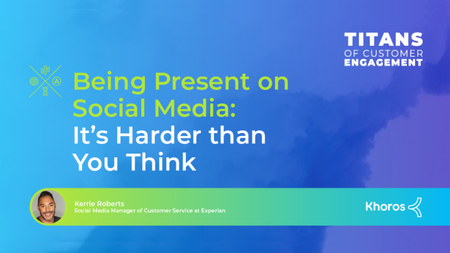
It’s finally here, and we couldn’t be more excited. The Customer Engagement team is proud to present the first episode of Titans of Customer Engagement: A Customer Experience Podcast, Being Present on Social Media: It's Harder than You Think featuring Kerrie Robert ExperianKerr, Social Media Manager of Customer Service at Experian. The Titans podcast features Khoros customers sharing best practices, insight on the evolution of customer and business demands, and what is or is not working when it comes to successful digital customer engagement strategies. Please share with your peers, leave us a rating or review, and continue the conversation in the comments section! Listen to strategic conversations with your peers and leaders about creating the world’s greatest customer experiences. Now available where you listen to your favorite podcasts Apple Podcasts Spotify Amazon Google Podcasts Stitcher TuneIn Also, don't miss out on CX Confessions: The Customer Experience Show, a thought leadership podcast on CX featuring C-suite executives Interested in becoming a Titan of Customer Engagement? Learn about what it takes to ascend to Titan status7.6KViewsSign in to react to this post1Comment3 social and digital trends to watch in 2021
Looking for insights to bring to your next team meeting? In case you missed it, we recently released Volume 2 of the Khoros Smart Social Report. Our Strategic Services team dug into Khoros Intelligence, native platform insights, and third-party data to identify three major trends impacting brands in 2021, along with the subtle trends that ladder into them. New tech has driven subtle shifts in the way consumers engage with brands and each other Overhauling content strategy as traditional brand social guidelines evolve Navigating sensitive moments means listening to your audience is essential Across the board, these trends showcase the impact on the consumer mindset, customer behavior, and brand responses in social communities right now. My favorite finding? Sound is BACK. If you’ve been in social long enough to remember the shift to soundless, text-heavy videos – this may be music to your ears [literally]. The mix of TikTok’s popularity, and at home listening habits during the pandemic, has shown that sound is getting smarter and is playing a larger role than ever before in how we consume content. Take a look at the report and let us know your thoughts in the comments below!7.3KViewsSign in to react to this post0CommentsForrester's Daunting CX Prediction and How CX leaders Can Overcome It
"CX leaders who can’t prove their value to the business will find themselves on the street. Those who do keep their jobs will do so by ensuring that their metrics and measurements relate to what matters most: KPIs with a dollar sign in front of them.” - Harley Manning, Forrester Research It’s no secret that those who have stepped foot in the newly chartered customer experience (CX) arena are feeling the pressure to show the proof in the CX pudding. And while Manning’s initial forecast did not account for a global pandemic, COVID-19 has only accelerated the race (not only against time and competitors, but most of all, against leadership stakeholders switching focus to other priorities) to create exceptional customer experiences that produce measurable business outcomes. Over the last five years of working for SaaS companies in the CX space (formerly at Topbox, I joined the Khoros team via the acquisition earlier this year), it’s clear CX pros understand why it’s mission-critical to translate CX program outcomes into dollars and cents - they are just grappling with how to do it. Understandably so. As consumer expectations continue to shift towards an "always connected, via any device or channel” relationship with brands, companies are providing customers with more options to communicate than ever before. The added complexity of more point solutions, more disparate data, and more silos makes it increasingly difficult to execute a unified CX strategy. Here’s the light at the end of the tunnel. Many CX leaders have been able to emerge out of the CX labyrinth with tangible benefits to show for it. They’re the professionals who have kept their jobs and increased CX adoption and investment at their company over the last year. In our upcoming webinar on May 26, Why CX Programs Struggle to Demonstrate Results, we will be discussing why customer experience professionals are failing to demonstrate the business impact of their efforts and provide actionable steps for how to overcome internal hurdles to transforming insights into measurable outcomes. We will cover: Three steps to proving the business results of your CX program Why the right data is key to transforming customer insights into business outcomes How to create a unified view of the customer at your organization Register for our webinar HERE If you’re unable to attend, go ahead and still sign up. We will send all registrants a recording following the webinar: Instead of heeding Forrester's message as one of warning, step up to the plate and invest the time to spring to the first proof points. We hope to see you there!6.7KViewsSign in to react to this post1CommentVote for Khoros-led panels to be a part of SXSW 2022!
The annual South by Southwest (SXSW) Conference & Festivals features a variety of tracks that focus on the most important breakthroughs in technology, film, culture, and music. Today, the public has the opportunity to vote for the panels they’d like to learn and hear about in the 2022 event programming. With a focus on digital customer engagement topics, including AI, purpose-driven marketing, and even a meet-up for digital leaders. Here are the Khoros-hosted Panels and Meet Up that you can vote for ahead of the March conference: URL to IRL: Khoros Meet Up for Digital Leaders: Join Khoros at this meet-up to connect with peers and experts across social media marketing, online communities, digital customer service, and CX. Network with brands from across the globe, share your stories, digital strategy best practices, and more. AI: More Intelligent Humans, Less Artificial Bots: There are many hypotheses surrounding the future of customer service agents -- “blended agent” models (combining voice and email channels, for example) are being piloted to some extent; AI investments are increasing with the promise to offload repetitive processes for agents to take on more meaningful work. This panel aspires to make an informed projection of the Future of the Customer Service Agent Experience, guided by research and a discussion from the people that will shape it -- BPOs who staff and train agents, contact center executives responsible for business outcomes, and agents themselves. Branded Communities: I Want You to Want Me: Branded communities are spaces for customers to connect, ask questions, and share their experiences. They’ve been around for some time, but 2020 brought to light how valuable they can be when there’s an absence of in-person communities, events, and human connection. As the world shifts to a digital-first way of living, communities have become vital to business strategies offering a self-service option for customer support, digital events, a space to connect with peers and fellow brand enthusiasts, and most importantly, a platform to build deeper relationships with customers. This panel will dive into the benefits — as well as challenges — of branded communities, plus, host a lively discussion around why communities are the new future of business. Fight Distraction with the Power of Purpose: Social media continues to evolve, and as a consequence, marketers believe there will be a focus on brands living up to and communicating their mission, values, and purpose-driven actions online. People are looking past the surface-level product and price, basing decisions more on how brands impact the world through their bigger purpose. COVID-19 has further underscored this importance and impacted brand strategy while highlighting the necessity of social responsibility for many brands. This panel explores the challenges of purpose-driven marketing and examines how the pandemic has influenced the resurgence of diversity and inclusion and other pertinent social issues. Along the way, you’ll learn about best practices and get a behind-the-scenes look at how brands navigate crisis moments. Hybrid Commerce: Digital Demand v Human Connection: Experts agree that, in the past 18 months alone, we have witnessed accelerated e-commerce adoption and growth. In 2020, digital sales surged as the pandemic forced global shoppers to rethink how and where they shop. Brands that survived the storm changed the way they marketed with digital-first mentalities and new commerce models. Yet a question arises: Now that we can buy everything from cars to groceries without ever interacting with another soul, is this digital-first model here to stay? Join Khoros, alongside leading global brands, as we present in-depth findings from field research that aims to answer what verticals still require the human touch, what experiences are going touchless, and finally, how hybrid models are changing the way we buy. Listen or Lose: Surfacing Data Diamonds: Data is growing exponentially -- we’re drowning in it. Real-time, behavioral data is superseding “state” data. At the same time, the market and consumer behavior is constantly changing. As these shifts rapidly occur, so does our ability to listen and leverage AI to actually mine data into knowledge and action. Which data sources offer the most value? What are the most practical applications of turning data into action? Explore big data with Khoros as we touch upon the mining opportunities and data ethics in the process. When does voting take place? Community Voting is open from August 10-August 26. How do I vote? Visit https://panelpicker.sxsw.com/ and select “Vote on SXSW Session Proposals” in the blue SXSW 2022 box. Sign In (if you already have an account) or Create an Account (if you don’t have one — it’s super easy, fast & free!), so you can vote. In the Search bar, type in “Khoros” to easily find our 6 proposals. Alternatively, you can search each full panel name or click the direct links above, once you’re logged in. Click on each entry, and cast your vote by clicking the “VOTE UP” box on the left-hand side. Click your browser’s back button to go back to the list of our 6 proposals, and repeat for each entry. Thank you for your support and votes!6.3KViewsSign in to react to this post2Comments