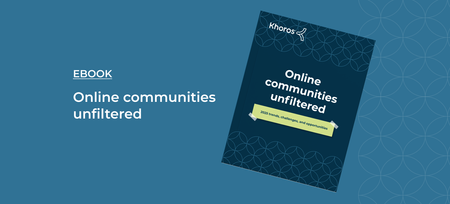
Online communities unfiltered: 2025 trends, challenges, and opportunities
We won’t sugar coat it — managing an online community is hard work. But the payoff of getting it right is unmatched. In this unfiltered guide, you'll get real-world insights and practical strategies from over 15 different industry experts on how to help your community thrive. In this guide, you'll learn: Trends shaping online communities — from tech shifts to evolving member expectations. The challenges community leaders are facing and how to navigate them without burning out. Actionable steps to drive engagement and business impact. Read the eBook here! 545ViewsSign in to react to this post
 0Comments
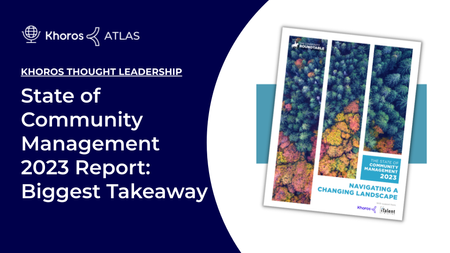
State of Community Management 2023 Report: Biggest Takeaway
In today's dynamic online community landscape, staying informed about the latest trends, challenges, and best practices is crucial for community leaders who seek lasting success. Discover the valuable insights and recommendations in The Community Roundtable's 14th annual report, The State of Community Management 2023, tailored specifically for community leaders. This report is a goldmine of tactics and strategies to enhance your strategic community planning and ensure your online community remains effective. We highly recommend you take a dive into the full report to get all the best insights, but here we’ve provided the top takeaway to help your community thrive in the ever-changing digital landscape. Harness the power of evangelism With the myriad of responsibilities shouldered by community managers, internal evangelism often takes a backseat. However, simply advocating for the value of a community may not be enough. It's imperative that the community manager isn't the sole voice singing the praises of the community within the organization. In The Community Roundtable’s research, 90% of best-in-class communities surveyed reported positive perceptions from executives. So how do you foster this support from leadership? Start by coordinating efforts and identifying team members who can act as champions to get support from middle management and executives. Holding the interest of stakeholders is essential to the long-term success of any community program. Why is internal buy-in so important? To start, building a thriving community is difficult. Not every business considers it a necessity, and some stakeholders may view it as a nice-to-have rather than a mandatory investment of time and resources. Tailoring your communication to different teams within the organization is key. For example, marketers tend to care about how a community can grow its audience or generate positive sentiment, while product teams care more about how the community will help them receive feedback from customers and further innovation. When each department understands its role in community building, they can allocate the necessary efforts and resources for a healthy and successful community. Above all, never stop evangelizing — seize any opportunity to speak to others within your organization about your community program. Although this can be challenging with the growing prevalence of remote work, make sure to communicate your message whenever and wherever possible. The more community evangelists who understand the language of community, the easier it becomes to promote the program throughout the organization. Take advantage of The State of Community Management 2023 to stay up-to-date on community management best practices, trends, and strategies. Download the full report here to learn how to navigate impending challenges and lead your online community to thrive in the months and years ahead.2.3KViewsSign in to react to this post0CommentsExploring AI Use Cases in Khoros Communities
Welcome to the Khoros view on our future with AI! It really is an exciting time for online communities in many ways, but we are just at the beginning of exploring how this technology will impact how we work in communities. At Khoros, we have been hard at work on Aurora, our next generation of online communities. While we have focused on our new technological foundation, natural language processing, and large language models have come to dominate the conversation in tech. Naturally, this has led to plenty of exciting discussions about the future of online communities. With Aurora, we are focused heavily on developing robust API’s, decoupling the UI from the backend of our platform, and building modern app experiences that will enable us to quickly tap into future trends in technology, whether it’s the metaverse or generative AI. What is Khoros working on now to further innovation in this space? There is much to explore with generative AI as it is still very new, but we will experiment and are planning on incorporating new technologies into our products. “One of the biggest initiatives we are working on is an orchestration layer for customer engagement that sits between these services and direct engagement with users offering the ability to control the use and workflows of that engagement. Whether it's easily swapping or testing new services, or putting the technology in front of humans to experiment and refine, we believe this will be a critical component of enabling and controlling the many use cases that these services make available.” - Nick Hill, VP, Product - Communities at Khoros There are some focus areas for us in product development with the application of generative and conversational AI. The most notable is the relationship between community-generated content and self-service / discovery. Five out of the top 10 sites on the internet today are communities of peer content. Communities rely heavily on SEO to index this content and on searches to drive traffic to the community. Generative AI offers a new approach - but it's still heavily reliant on the continuous sharing of user generated content. With the incredible scale of 18M new posts per year and hundreds of millions of solution views across all Khoros communities, the fundamental need for experts to share, and the need for others to find is unchanged. However, the approach of crawling and links will shift to summarization and intelligence responses. Some exciting new capabilities will be to build on your query, or to generate questions where knowledge is insufficient. Another opportunity we have is exploring the improvements for content moderation. Generative AI tools can help us better caption and classify images and text, which reduces the need for manual moderation and helps improve moderator mental health. This addresses spam and inappropriate content in new ways and adds much more to the moderator's set of tools. However, we’ve al…6.3KViewsSign in to react to this post2CommentsThe Metaverse and Online Communities: Khoros 101
“Metaverse” is a term first coined by Neal Stephenson in his 1992 science fiction novel Snow Crash, captured the imagination of emerging generations and has gained unsurprising traction in recent years. From fully digital lives in online worlds, like Second Life, to a plethora of movies like Ready Player One, each provide a glimpse into what the metaverse could mean and how it could play a part in our daily lives. As we’ve seen, the mission, vision, and values that we hold for our futures are the premise of how these new worlds emerge. It’s not hard to find media covering the topic of virtual worlds, they are real, they exist now, and yet there is so much we have yet to see as far as technological developments in this area. The current understanding and experience of the metaverse varies. Although Meta (formerly Facebook) is creating its own “Metaverse” it is only one of many such projects. There is Meta, the brand, and there is the all-encompassing term, metaverse, which essentially means multiple worlds enabled through augmented and/or fully virtual experiences, where people can interact, work, play and more. Brands, opportunities and partnerships are ripe across this ever-growing ecosystem — many organizations are currently building out similar and novel virtual experiences for work, commerce, entertainment and more, across a spectrum of centralized and decentralized systems. As it stands, the metaverse is what we would say is in its ‘prototyping’ phase. Thus, there is so much yet to come, and infinite possibilities in which we can partake. Metaverse and online communities You can’t have a metaverse without community. Think of the metaverse as just like our real-life public and private spaces, except augmented / fully digital with a game-like, fantastical structure. Metaverses are narrative driven and hosted for connection between people, groups, and organizations. And the glue that holds these worlds together and enables a new epoch of collective experiences is the community aspect of them. We can see large-scale examples of metaverses with the recent explosion of worlds like Decentraland, Sandbox, and Roblox. Worlds like these will only become more extensive and are increasing in number over time. Here we will dive into the role of communities in the metaverse and how the evolution of key community considerations provide emerging opportunities for Brands: Enabling a greater sense of meaning Rewards and recognition Ownership Scope and collaboration Social media to social experience 1. Metaverses can enable a greater sense of meaning In contrast to other technologies, metaverses are unique in the advanced sensory experiences they offer through augmented reality and full immersion VR. Avatars let people connect through body language, expressing themselves in real time. With so many added layers of connection and exploration, they come ever closer to real-world-like interactions, …8.1KViewsSign in to react to this post3CommentsCommunity ROI: Embracing Humanity’s Desire to Help
In today’s digital ecosystem, it’s a requirement to have a community page. No matter what industry you find your brand or company in, having a place for your customers to talk about your business, find support, or ask questions is necessary. Long before Khoros was Khoros, the founders deeply understood the importance of digital communities. It’s easy to hark about how much value you can pull from having an award-winning community. However, few articles and resources are diving deep into exactly why brands are finding these high levels of value and success with their digital communities. This article aims to change that. Of course, it would be a misstep not to recognize some essential realities of running a digital community. The initial bottom line is that running a community costs money. There is no escaping or not paying the hosting, designing, security, and general staffing costs. It could cost anywhere from the low tens of thousands to millions of dollars a year. As the intrepid new community, you might find yourself needing to garner more executive support. You have to consider not only why people use community pages but also how you will find value in all aspects of the customer experience by having a highly successful community. Care and Community Utilizes Human Desire to Help one Another Khoros and several of our customers have proven that customers in need of support rarely care where they receive that support. In regard to digital communities, one of the most engaging types of posts is a support question. Even Google’s algorithm will point customers toward a digital community to answer product or service-related questions. This system is adventitious for whichever brand or company owns the community page, but why would any customer spend their valuable time and resources answering strangers' questions on an online forum? For some community managers, this question isn’t of massive importance. It’s extra work and research to understand why customers answer strangers’ questions in digital communities. However, if your community page starts slipping towards inactivity, you find yourself struggling to understand why your page isn’t being used as much anymore. People tend to help one another for various reasons, but it generally breaks down to our evolutionary hardwiring. This will defer slightly from intrinsic and extrinsic motivations, but the rewards are generally the same. One of the most significant motivating factors is that humans are generally socially ousted for being a “freeloader” or “lurker” in communities or social settings. In Sebastian Junger’s sociology exploration book Tribe., this isn't a new concept. He explores how helping your fellow human was quite literally law in most of ancient society, saying - “This [helping in social setting] is clearly an ancient and adaptive behavior that tends to keep groups together …3.4KViewsSign in to react to this post0CommentsTaking Dr. Micheal Wu’s Gamification Theory into the Real World
Years ago, long before Khoros was Khoros and was simply Lithium technologies, a rather curious and beautiful theory was introduced into the world of digital communities. The idea was that if you added some version of gamification and the proper motivation to community users, the digital community would outperform most of its competitors. Gamification floats through various strategies and online communities, but what exactly is gamification in the context of digital communities? In as few words as possible, it is the process of rewarding users with digital badges and increased access or features in the community. Gamification is a prime example of using extrinsic rewards versus intrinsic rewards to influence more people to use a community page. Former Lithium data scientist Dr. Michael Wu explored this concept concerning gamification back in 2014. All of Wu’s findings are far beyond the scope of this one article, but in short, Wu theorized that you could use both intrinsic and extrinsic rewards in the gamification of a community page. If you are not familiar with intrinsic and extrinsic motivations a nd rewards, Wu said it best in his original article: “An intrinsic reward is an intangible award of recognition, a sense of achievement, or a conscious satisfaction. For example, it is the knowledge that you did something right, or that you helped someone and made their day better. An extrinsic reward is an award that is tangible or physically given to you for accomplishing something. It is a tangible recognition of one's endeavor. For example, it’s a certificate of accomplishment, a trophy or medal for winning the race, a badge or points for doing something right, or even a monetary reward for doing your job.” This theory applies to almost every single human interaction or action. The key difference between the two motivation and reward systems is longevity. Generally speaking, intrinsically motivated people will almost always continue to perform an action or task. A great example of this is the super users of a community page without any game theory applied. The super-users will continuously engage with a community page because they genuinely love to use the website. However, according to the Nielsen group, only 1% of all website users will seriously contribute to the page. For the other 99% of the community, the question that Wu was aiming to answer was what would motivate them to start engaging with the website. His answer was to use game theory to increase extrinsic rewards and motivation. This can be done simply by adding more features, rewards, and badges that you can proudly display as a community user. Khoros customer Pandora did this exceptionally well. So, what exactly did Pandora do? Pandora embraced game theory in a wonderfully organic way. At the start of introducing the Pandora community, users were already looking for ratings. By adding a simple r…4.3KViewsSign in to react to this post1CommentAn Interview For Change: Digital Community Challenges & Opportunities
Since the start of digital communities, it has been known that they can be powerful beyond measure for brands imploring their use. However, due to their rapid growth, creating the right processes and governance structures can be a serious challenge. To explore digital communities more, I sat down with Lisa Bidder, Customer Solutions Director and former Strategist & Community Manager, to get the inside scoop on the challenges and opportunities brands can find with digital communities. Parker Hicks Can you tell me a little bit about your background and why you chose to come to Khoros? Lisa Bidder Ooh, great question. I didn't choose to come to Khoros, there was no career plan. I got into online communities as a gamer. I’ve been gaming since Chuckie Egg, 1986 I think, I was a little obsessed with it. I was away from it for a while, work, life, being a girl, all got in the way, but got back into it when my children were young, that's when I started using online forums and communities. I wasn't working at the time because the children were young and I found myself volunteering to moderate and administrate, and just very quickly got into [community] managing gaming communities, ended up building my own (XboxGameZone) and found myself, somewhat by accident, consulting others on their communities and how to do it. Long story short, before I knew it I was working in the games industry doing something that I absolutely loved. I’d had a variety of different jobs over the years that paid the bills, but weren’t particularly interesting, it was just work that paid the bills. But there I had a variety of responsibilities, setting up online gaming tournaments, managing the community, and doing some work on their social channels. I was in that role, with a variety of responsibilities for quite a long time when someone I worked with moved to what was then lithium. They knew I’d been looking for something more challenging and said this was the place to be, so I applied for the job and I'm still here because they were right. What were some of your challenges when you were community managing? The challenges I experienced probably all circle back to the result of a lack of process in some way, shape, or form. I'll give you two very specific examples that are vastly different, but both came back to a total lack of processes in the organization, the way it was structured and the maturity of the community, and how it existed within the business at that time. One of them, we were experiencing a variety of problems and as I dug in I realised there was absolutely no governance over access and permissions within the community. So anybody could do anything? The normal community members could do all of the things that they were supposed to do, this wasn’t true for others. It was a very large organization, there were lots of people within the busine…2.8KViewsSign in to react to this post0CommentsHospitality Brands: Facing the Pressure with Digital Solutions + NEW AUDIBLE VERSION
Don't have time to read? Check out this audio version of our blog, also found on your favorite podcast platform! Everyone has had those horrid travel days. Everything seems to go wrong. You forget your passport, your wallet, or worse still, you forget your headphones. Nothing seems to top off a bad travel experience than a flight getting canceled or having a hotel lose your room reservation Unfortunately for millions of people in recent memory, having a flight canceled is practically baked into the travel plans. The frustrations of dealing with the various customer care teams aren't generally baked into their travel plans. For whatever reason, certain travelers are left on hold for hours, and for better or worse, these travelers are forced to use only a handful of support and engagement channels. Khoros is here to prove there’s much more to customer engagement in the travel industry than Twitter and outdated phone systems. A New Approach It’s clear that travel brands need to expand their reach into new channels and customer engagement methods, but what might be the best path to accomplish this? Thankfully, Khoros’ customer Airbnb has provided a perfect game plan. In 2020 Airbnb was rated best in class for their community using the Khoros platform. A principal reason for this award was Airbnb's ability to empower its community users. The Airbnb community supports five different languages, and hosts and guests can use the community to customize everything about their accounts and experiences. The community is known for organizing meet-ups and idea sharing, and most importantly, guests and hosts can get community-based support whenever there's a problem. While it seems almost too simple to work this well, Airbnb proved that a strong community could increase customer engagement passively. You can read the full Airbnb kudos award here! Customer Engagement Means More than only Care It’s generally accepted that most people will only interact with a travel brand when they have a question or issue they need resolving. However, only focusing on the care side of engagement would be a rather significant misstep. Marketing in new channels to draw in new customers is a delicate dance. It's crucial that you stay relevant with the new customers but in a way that might alienate your current customer base. Irish Airline Ryanair has taken this in stride with their viral TikTok account. For the unaware, Ryanair is a budget airline known for many things but known that it’s the cheapest way from point A to point B in Europe. However, not always the most comfortable. There won’t be a lot of bells and whistles. Countless jokes circulate on Twitter about how there are no windows for specific seats on a Ryanair flight, the landings can be rough, or what have you. A brand could do one of two things. Either they could not engage, or they could …4.4KViewsSign in to react to this post0CommentsAre you There ROI? It’s Me Care: A Cost Savings Series from Khoros
Customer care is convoluted at the best of times. While the customer can use your product or service wrong once, your customer care system has to be right every time. Of course, this is a fool’s dream because of Murphy’s law. In other words, whatever could go wrong, will go wrong, except when they don’t. A few years ago, a Khoros customer found truly stunning success while using the Care platform, even when the odds were stacked against them. This customer had to juggle a massive merger, adoption of the Khoros system, and dealing with a vast influx of volume during a nationwide event and promotion. Previously used Care models suggest that these factors would cause this customer to crash and burn. However, they found nothing but success in their first year of using Khoros. Over the course of a year, this customer successfully handled over 15,000 customer messages per quarter and saw a 13% agent efficiency improvement. During that nationwide event, with hundreds of thousands of people watching, this Khoros customer handled over 25 customer contacts a second. So, how did they do it? Was it the stars aligning? Some kind of holiday miracle? According to Ockham’s razor, the simplest answer is often the most correct one. In this case, the most correct answer is that this specific Khoros customer implemented two incredible and simple tactics to boost their Care efficiency. The first was queue configuration, or how to organize the flow of your customer requests in the most efficient way possible. The second was enabling Push Next into their system. Put simply, Push Next removes extra clicks that need to be made by a care agent by having the platform give the agent the subsequent customer request rather than the agent having to choose which ticket or request to address. Let’s dive a little deeper into how queue configuration and push next can help solve high volume and low agent efficiency by first looking at a care team who has chosen not to implement both ideas into their care system. Queue Configuration How a team routes their customer requests will depend heavily on the type of company setting up their care configuration. For this example, we’ll use a monthly subscription streaming service that recently had a server go down, resulting in the loss of service for thousands across several regions. This streaming service’s customer care channels have exploded with requests and tickets. To add to the problems, a group on social media is fanning the flames of the public reaction. Because of the social media reaction, this team will have to tackle both real customers trying to get answers to why their service is down or cancel their subscription and non-customers and internet “trolls” calling with fake or nonsense issues. This streaming service didn’t use customer sentiment detection to configure its queue in a way to maximize its efficiency and is now stuck with a tidal wave of…3KViewsSign in to react to this post1CommentServing Customers in the Face of Crisis: Redux + NEW AUDIBLE VERSION
Don't have time to read? Check out this audio version of our blog, also found on your favorite podcast platform! The digital world is no stranger to crisis It started with the .com bubble, Y2K, and any number of brand social faux pas. What effect this has on a brand depends heavily on how robust the brand’s marketing, community, and customer care systems are. In an age when everyone can be a video journalist or digital columnist, a brand’s simple mistake can end up costing hundreds of thousands, if not millions of dollars. Even when brands are in crisis and damage control mode, the wheels of business keep turning. This fact is especially true in the diverse world of customer care. For example, a company spokesperson makes a Freudian slip in a viral interview. Next, a group of people, through the power of social media, band together to make hundreds of calls to your contact center and tweet thousands of times to your brand in a day to display their disdain for your brand. This group of people bottlenecks your agent’s ability to help any of your “normal” customers who still need support. Of course, the simplest solution is to unplug your phone system and focus all efforts on damage control. While this might save some face in the short turn, not reinforcing your care systems will affect more than just a few angry customers on Twitter. Look no further than above your head into the world of commercial travel for a real-world example of crisis mode care. Every day, thousands of flights take off and land; unfortunately, in recent times, thousands of flights have been canceled globally. At the time of writing, international and aviation-based travel has exploded to nearly 180% compared to 2021 levels. On top of the increased demand, major airline employee strikes have decimated staffing levels across Europe. It’s fair to say that airlines are in crisis mode currently. How has this crisis mode ended up with major airlines across the globe? Some of the lowest rated NPS score across digital care, the longest TAR, and the poorest agent health. According to the New York Times, some people who attempted to contact an airline’s customer care team reported waiting on hold for 275 minutes. Of course, some airlines nail digital care, and other industries facing backlash can still provide excellent customer care. These brands share a common thread that customer care systems widely center around being digital first. Here are the three fundamental ways they were able to keep their customers happy during a crisis. A Focus on Agent Health with Digital First Many people would argue that being a customer care agent is widely a thankless job. It’s stressful; agents face unpredictable hours, and generally speaking, customers only contact the care team when they are facing problems or issues. Now mix in a time of brand crisis. Using the above example of an angry group of people clogging…3.3KViewsSign in to react to this post0Comments