2023 Khoros Kudos Winners & Finalists
The Khoros Kudos Awards is an annual customer awards program that recognizes leading B2C and B2B brands who innovate to connect, service, and establish trust with their customers through the modern digital channels people prefer, including social media, websites, brand messaging, online communities, and more. We’re excited to announce the winners and finalists for 2023! ESRI: Best-in-Class: Community Winner Finalists: Zoom, Bell Canada, and Intuit Turbotax Bell Canada: Best-in-Class: Digital Customer Service Winner Finalists: Qlik, Three Ireland, Swisscom AAA: Best-in-Class: Social Winner Finalists: NSW Department of Customer Service, Promega, Lucky Mobile Intuit Quickbooks: Holistic Customer and Digital Engagement Winner Finalists: Canon USA, SMARTY, AAA Bombardier Recreational Products: Keep Calm and Carry On Winner Finalists: NSW Department of Customer Service, Mediacom, BT Ancestry: Partners for Life Winner Finalists: AAA, Virgin Plus, STIHL Watch the full video compilation of all of these stories on Khoros.com. Thank you to everyone who submitted this year. We’re looking forward to announcing information about the 2024 awards early next year. 3.3KViewsSign in to react to this post
 0Comments
Driving Growth in Community with Banners & Content Gates
Recently, CheckMates introduced banners aimed at encouraging our community users to log in or register. This fairly simple idea has already proved successful, so I thought it could be helpful to others. In thinking about this, it was just one stop on a much longer journey. So first, a little history. Check Point was a Jive customer, but there wasn’t any actual formal program before the CheckMates community program started in 2017. In 2015, a different community lived on JiveX, which became CheckMates, and migrated to the Lithium/Khoros platform in 2019. We dialed in on tracking Member Registrations to demonstrate overall community growth to our execs. We recently started being interested in Member Entrances, but first, let’s look at the metrics we’ve been tracking consistently, Completed Registrations, as these metrics are related. Historically, we’ve been getting roughly 1,000 registrations a month. When this number dips below 1,000, we start looking at what we can do to encourage more registrations. Most of our content is available without logging into the community platform. But we have some content restricted to only logged-in users for various reasons, including ensuring users log into the platform. In the old JiveX platform, the only way to make content available when logged in was by putting it in a space that isn’t accessible to someone not logged in. The downside to this method is content won’t be indexed by Google—an important consideration when you consider the vast majority of our traffic comes from search engines. When we moved to the Lithium/Khoros platform in 2019, we developed a custom component to “gate” specific posts. If users have not logged in and hit a gated post, they’ll be presented with a preview of the top-level post in the thread, and the rest is hidden. Below is a visual of the preview, or you can see this in action here. When we first implemented these custom components, I hard-coded the thread IDs into the components. The downside is that it requires pushing code changes through Studio anytime I wanted to gate a post. I now use Custom Tags, which made it possible to not have to push a code change whenever we wanted to update which posts were gated. Note that our general guidelines for gating posts are as follows: Top 25-50 threads by visits (reviewed quarterly) Content related to events (always gated) This idea kept the numbers above 1000 a month for a while. Earlier this year, we started noticing the numbers dipping below 1000 a month (our low was 800, I think), so we started looking for new ways to bump that back up. So, we added a banner to remind community members to log in and encourage prospective members. Sometimes, innovation isn’t complicated. Showing a popup on a specific page when the user is not logged in is pretty easy by including the component in relevant layouts. We had been experimenting with a third-party service to display this popup. But I decided to roll up my sleeves and write my own. Learning how to keep it from not showing after the user has clicked on the X to close required me to understand how to work with cookies. 😊 One thing I failed to account for in the design was that the Khoros platform doesn’t provide a way to track these clicks (Google Analytics wasn’t showing me either), so I had to route the clicks to a URL shortener. That meant the results weren’t directly tracked for a few weeks. And the results? Member Entrances increased noticeably, from 37k/mo in July to 42k in August and 45k in September. Completed Registrations went up from about 1,100 to about 1,200, the delta corresponding to the number of clicks received to create a new account. These simple tactics can help maintain momentum for those using the Community product, as our early returns suggest they directly contributed to moving the needle for our community.9.5KViewsSign in to react to this post21Comments2022 Khoros Kudos Awards Winners and Runner-Ups
The Khoros Kudos Awards is Khoros' annual customer awards program, in which we collect and reward customers on the incredible success stories they have with Khoros We received 77 submissions across 11 categories this year, and the following were determined by our Atlas Community and our expert judging panel as the Winners and Runner-Ups: Holistic Customer Engagement Platform: Viessmann (Winner),General Motors and Swisscom (Finalists) Best-in-Class: Community: Three Ireland (Winner), PowerSchool, and Spotify (Finalists) Best-in-Class: Digital: Orange Belgium (Winner), Bell Canada and Virgin Plus (Finalists) Best-in-Class: Insights: Intuit (Winner), Verizon Communications and Randstad (Finalists) Check out Randstad's episodes on the Titans of Customer Engagement Podcast Best-in-Class: Social: BMW x Accenture Song (Winner), Promega and Thermo Fisher (Finalists) Bottom Line Savings Rock Star: Flexera (Winner), Upwork and Verizon Communications (Finalists) Check out Upwork's episode on the Titans of Customer Engagement Podcast Engagement for Good: Truth Initiative (Winner), Révolutionnaire and Alteryx (Finalists) Keep Calm and Carry On: Zoom (Winner) and Vodafone Portugal (Finalist) Check out Zoom's episodes on the Titans of Customer Engagement Podcast Partners for Life: Palo Alto Networks (Winner), Target and Virgin Plus (Finalists) Rookie of the Year: F5 Networks (Winner) and Zoom (Finalist) The Innovator: General Motors (Winner) Congratulations to these customers, and thank you to everyone who submitted this year!5.8KViewsSign in to react to this post4CommentsOracle Cerner’s Kandice Eckhoff: The Pros and Cons of Group Hubs
When Blake asked me to write about how our community manages our groups, I was not sure what to write about. We have had groups for so long at Oracle Cerner that we assumed everyone else does too. My name is Kandice Eckhoff, and I am the Product Manager for our Khoros platform, Oracle Cerner. I have been with the company for almost 12 years in various roles and in my current position for six of those years. uCern is Oracle Cerner's collaboration platform used for client-to-client and client-to-associate collaboration on our products and services, ideation, and assists with ticket deflection by providing answers to client questions. uCern was started in 2009 on the Jive platform, and at that time, we let anyone create a group. This was not a good idea. I would NEVER recommend this for a community. We ended up with groups like "Cat Lovers," "<Insert College Name> Alumni, "New Moms," and the like. While the intention at first was good, just getting people using the community, it quickly got out of control. We eventually locked down group creation. New groups are evaluated by our team and created based on business needs. By then though most of the damage was done, and our clients were complaining about search results pulling in random information or stale content. Group owners would leave the company or change roles, and groups were no longer active or responsibly managed, so we ended up with a lot of those. In 2018 we separated associate-only collaboration to help with some of the confusion. During this time, we archived groups, spaces, projects, etc. with no created content or activity within the prior year. Subsequently, when we started planning our migration to Khoros, we again started an archiving exercise to minimize the amount of data we would bring over. We were able to purge 55% of our groups because of this effort. When we migrated, we brought over 2,254 groups. That number has since grown as we have weekly requests for new ones. The need for them varies: private collaboration for specific clients and associates, aligning groups with our products, and associates realizing the need for collaboration on certain topics or markets we are in. As you can imagine managing this number is difficult. Permissions are a nightmare, community engagement is difficult to monitor accurately, and the removal of the "old stuff" surfaced older stuff clients have found inaccurate. In turn, the cycle of constantly curating our content continues. We are repeatedly told no other Khoros client uses groups the same way we do, hence being the group hub unicorn. So how do we manage this many groups? It is not easy. We are currently looking at archiving more inactive groups and realigning our community structure based on feedback we have received. Ideally, we will end up with 1:1 product groups and a couple hundred non-specific groups that remain for topics, regions, or are role specific. For those of you that do use group hubs and now have access to manage the group role permissions at the global level…you're welcome. 🙂 That was done at our request due to the number of groups we have and the time it took to update any changes since we had to do them manually. Thankfully, we have a team that can automate processes, and we were able to minimize the time spent making manual updates while Khoros built the functionality we needed. Here is my advice to any community managers planning to implement group hubs: Have a plan - I know it seems like an easy decision, but you need a plan for who will handle creating the groups. Once they are created, who will monitor or curate the content? How do the groups fit into your community structure? Will you have groups at the global level, within categories, or a combination of the two? Plan for quarterly, semi-annual, or at the very least annual archiving of inactive groups. If you are the community manager, the responsibility to monitor the ENTIRE community should not fall on you. If someone requests a group, they need to own all the group responsibilities. That includes answering questions, finding the answer if they do not know it, posting at least weekly to keep the group active, and making sure group ownership is updated as needed. Have a group dedicated to just group owners so you can communicate with them. Take a look at the resources below to learn more about Group Hubs in Khoros Communities Group Hubs Overview and Use Cases About Group Hubs Group Hubs Onboarding Videos Group Hubs Best Practices11KViewsSign in to react to this post6CommentsA Python Library for Khoros Community
Photo by Hitesh Choudhary on Unsplash One of my favorite things about working at Khoros and writing about our products is that I get to witness the Khoros mission play out in real-life situations. This happens often in chat experiences I know are powered by Modern Chat and the Khoros Automation Framework, and I also see it in brand outreach via social media. But one of the most rewarding examples is when I see something exemplifying the power of Community – connecting, helping, and sharing with the intention of making life easier. Community is more than a product. It's a mindset. Today we're highlighting a contribution by a developer who embodies the Community spirit. He built an open-source Python SDK for Khoros Community and we want to share it with other Community customers. Other developers working with Khoros Community have already contributed to his project. I got a chance to chat with this developer over Zoom to learn more about his Khoros journey and the Python library. Note: The Python library discussed in this article is not part of Khoros's official Community platform, has not been tested by Khoros, and is not supported by Khoros. Q&A What does the Python library provide? I've tried to keep the library flexible to support different work patterns. I built it to be as generic or detailed as a user needs it to be. For example, you could use the khoros.messages.create function to create a message or simply use khoros.get if you just want a shortcut for a GET request. At a high level, the project package is comprised of Primary modules, including the Core object and module and Supporting modules. The Core object/module object is your hub. You'll Instantiate the Core object by passing Khoros credentials. The Core module is a collection of core functions and tools to work with the Khoros Community APIs. Other Primary modules: handle interactions with the Community REST APIs facilitate authenticating to Khoros Community environments enable API queries using the LiQL syntax provide functions to work with various Community API objects and structures (e.g. community, categories, nodes, and tenants) facilitate working with SAML assertions retrieve Community Plugin SDK details (SDK and dependency versions, installation state) The library's Supporting modules: contain classes supporting error and exceptions handling provide tools and utilities like dictionary conversion, timestamp formatting, and environment variable retrieval/update help with their Community Plugin SDK set up and publishing support helper file import and parsing to facilitate ease of use and configuration setting for the package perform unit testing What are some of the more popular modules? Probably the Objects module. The functions to create and update users and roles are heavily used. Publishing messages on behalf of other users also gets a lot of use. Other functions simplify cumbersome processes like creating a message with attachments. I thanked my past self for writing that when we migrated legacy intranet content to the community. I find that developers new to the Community REST API struggle a bit with API v1. The V1 subclass provides methods for performing base v1 requests. What have you and your team been able to accomplish with the SDK? The Objects module enabled a lot of automation and migration tasks like moving posts out of one system and into Community. When we migrated to Khoros, we used our library to create our new Community Structure – over 200 nodes. We were able to put the community structure into a CSV file, ingest that with the SDK and let the library create our node structure for us. It saved us a ton of time. Also, we publish security advisories in the community. Generally, these are legally-mandated advisories of security vulnerabilities and other important issues. We've used the SDK to auto-subscribe customers to notifications in various group hubs so that they receive the announcements automatically. Community didn't support the functionality we needed out-of-the-box, so we built it. We publish advisories via the API under a pseudo-account (like Product Manager) when we publish advisories. We do this to avoid a single employee from being bombarded with DMs simply because they published an article. Again, the SDK helps us automate that process. Where do the library and SDK fit into your day-to-day programming work? We have 9 people on our Community development team. We have back-end and front-end developers across the globe who use the SDK daily to complete their tasks maintaining and improving the site. We've also used the SDK to build automation tools for other groups. We built a documentation integration with MadCap Flare. The Dev team built a tool where they can export content from MadCap, push it to a Github repo, and use a homegrown administration panel that enables the writers to publish the content to Community. Basically, Python scripts parse the content to make it compatible with Khoros Community and use the API (via my Khoros package) to systematically publish the content on our community and dynamically construct a Table of Contents component. I see additions in the changelog from folks outside of your organization. It looks like other people are starting to discover it. When did you begin to get traction with regard to open source? I added a post to Dev Forum about the SDK earlier this year. That drove some people to it. I've been building functionality and added updates most months since I launched it. One developer reached out through Atlas about LithiumSSO. That person and I collaborated and got the code included (including documentation). It's been a great way to connect with other Khoros customers. I can see the downloads from the Python Package Index (PyPI). It feels great to receive enhancement requests and pull requests. Since you mentioned documentation, may I geek out momentarily with a writer question? Your Python library is nicely documented. How did you find Read the Docs for documentation? So, I'm a Humble Bundle fan. They had a special on Python books at one point that included a book called Serious Python. That book turned us on to Sphinx (a documentation generator) and then Sphinx brought us to Read the Docs. It pulls documentation right out of the code comments. It's been really convenient and it was straightforward to set up. How do items get on your Roadmap? I use the Issues section in the Github project as a baby JIRA to collect bug, code enhancement, and doc enhancement requests. I get a few each month and pick them up as I can – or else I brainstorm for cool things to add when I've got some spare time. Final thoughts Thank you so much for building this and for talking with us today! Follow the links below to view the library project and documentation. Check it out, give it a try, and maybe even contribute some code of your own. Happy coding! Python Library Documentation Python Library on PyPI Python Library Github repository653ViewsSign in to react to this post0Comments[Titans] Don’t Forget the Cheerleaders! How to Win Over Internal Stakeholders
A few weeks ago, I had the opportunity to watch my niece’s cheerleading championship. First, these are frightening to watch when someone you love is ‘in the game’. The tosses, flips, and catches keep you at the edge of your seat with ‘91’ punched into your cell phone. Second, you realize very quickly the power of having someone on your side, shouting out your name, and proudly sporting your colors. It made me think about how cheerleaders have been critical in the success of every effort in my career. As you can imagine, when I was launching a private unified B2B customer community in late 2020, I knew I needed cheerleaders. As a community professional with over 4 years of experience (and 28 years in business), I’ve found the best way to grow your squad is by following the ABC approach. Acquaint Our organization, Datto, has approximately 2000 people. This is just big enough for there to be people who have no idea we have an online Community. My remedy: Internal PR tour A video My tour included the Sales, Success, Product Management, Business Development (Biz Dev) teams - anyone who would listen. I could give anywhere from a 2 minute to a 20 minute presentation on Community. Two minutes is clearly the biggest challenge. As Mark Twain once wrote “I didn’t have time to write you a short letter, so I wrote you a long one.” First, create the perfect version at the perfect length to present your background, your “why should I care,” and then your call to action. Next, shorten that presentation before you are forced to in a meeting. Be ready to adapt and still get the essential points conveyed to your audience. Finally, create a video to spread your message even when you can’t be present. Make multiple versions to provide each key role the answer to the question “How do I benefit from promoting the Community?” That brings me to the B in the ABC formula. Benefits Cheerleaders need to be given a reason to shout and something worth shouting. This is where benefits come into play. When building your squad, you need to clearly define the benefits to them. The reason to shout depends on your Community. For our company, it positions the employee as an individual our customers can reach out to for great resources. What you shout depends on the team to which you’re speaking: Sales - Shouting Community shows our customers we continue the conversation after the sale. Success - Shouting Community shows our customers they have a place to influence our product and connect with their peers. Product Management - Shouting Community shows our customers that they are engaged to listen to their suggested improvements. Biz Dev - Shouting Community shows we are not just about the occasional in person connection. We want them connecting and learning long after the drinks have stopped flowing. Your reasons will vary - however, you must identify them and shout them yourself before others will shout along with you. Give your cheerleaders the reason and the chant, and they will make it shake the Community rafters. Connection To be honest, the formula is ABC 2 where if my algebra serves me correctly, only C would be squared (C x C). But I digress. Continuous Connection is our final component. That means staying in touch with your cheerleaders. Meet often with your biggest cheerleaders 1 on 1 or in a small group. Slack or message to inquire how the chant is being received. Ask what content or events could make them yell louder. Ask if there are new groups that need to join the squad. The ABC method has created cheerleaders that help me brainstorm Ask the Expert events, create consistently great product release posts, and approach me when they need assistance with reaching more customers. This process is always a work in progress. We are humans dealing with busy humans to speak with other busy humans. Do you see the theme, and thus the triple challenge, in this effort? This year, we are creating a Community Planning Committee to formalize a portion of the cheerleading squad and we are adding in a technological cheerleader (Walkme). If you're ever interested in brainstorming ideas, feel free to private message me. I am always up for a brainstorm.5.6KViewsSign in to react to this post3Comments[Titans] How the Cisco Meraki Community Uses Blogs
Editor's Note: CarolineS is one of Khoros' top Titans, our community of pros who are skilled at building customer experience programs. Now an independent consultant who helps brands get the most out of their community platforms, she shares her experience below of using Khoros blogs to help build the Cisco Meraki community. Take it away, CarolineS! A blog post about blogs! I’m excited to contribute to this new Khoros effort to showcase real-life community examples. Thanks for the opportunity, BlakeH! One of the things I love most about the Khoros Community platform is its flexibility. Sure, it comes with a few standard interaction styles (blogs, forums, knowledge base, contests), but a clever community team can do a lot with these base types. Just the blog interaction style has a lot of possibilities - we have used it to solve a myriad of use cases on the Cisco Meraki Community. For example… Community Announcements This community-centric blog is perhaps our most typical “blog”; we use it to keep our members appraised about contests, member recognition, and platform updates. The layout is that of a standard blog, with a running list of posts. In addition to posting announcements here, we use Marketo to email our members about new contests and select other announcements. (Can you guess, of the two posts shown in the screenshot above, which we sent an email about?) See our Community Announcements blog for yourself here. Service Notices blog Our support team uses this blog to post about outages and other wide-scale problems. They link to these posts from within our product’s dashboard and also in customer email communications as needed. We were thrilled to be able to create this for our support team (with, frankly, very little effort). Hosting these outage notices certainly aids us in our goal of deflecting support cases! Take a look at the Service Notices blog here. Podcast We also use a Khoros blog as a home for our podcast, Meraki Unboxed. Posting the podcast episodes on the community gives members the chance to provide feedback on episodes and to interact with our podcast host. The podcast blog is here. VIP Program Roster / Hall of Fame One of our less-traditional uses of the blog interaction style is our Community All-Stars Hall of Fame. Here, we post photos and biographies of each of the members of our VIP program. We use labels to designate which year(s) they were members of the program, creating a historical record as well as an up-to-date roster. This blog uses the “masonry” layout for a more photo-rich look. You can see it for yourself here. These are just a few of our uses of blogs - believe it or not, there are more! But that’s enough about how the Meraki Community uses Khoros blogs. I’d love to know how YOUR community uses blogs. Please do share in the comments below. Questions? Join the discussion by registering or signing into Atlas.9.8KViewsSign in to react to this post7CommentsKhoros Kudos Deadline Extended to June 4th!
Here’s some good news to start your week: the Khoros Kudos Awards deadline has been extended to Friday, June 4! This gives you an extra week to pull together your story and share your successes in the 12 award categories. Best-in-Class Care Best-in-Class Community Best-in-Class CX Insights Best-in-Class Marketing The Accelerator All-Ways Connected Better Together: Customer Engagement Bottom Line Savings Rock Star Keep Calm and Carry On Rookie of the Year Small But Mighty Top Line Growth All Star We’ll announce the winners on Atlas, Khoros social media, and at our virtual Khoros Engage on September 22-23. All award submissions will be highlighted as part of the virtual event, with peer recognition by 1,500+ attendees. More information about the Khoros Kudos Awards can be found on the contest page on Atlas. Check out our winners and finalists from 2020 for inspiration telling your story! We look forward to celebrating your successes with you!8.9KViewsSign in to react to this post3Comments
New Khoros Community: Visible
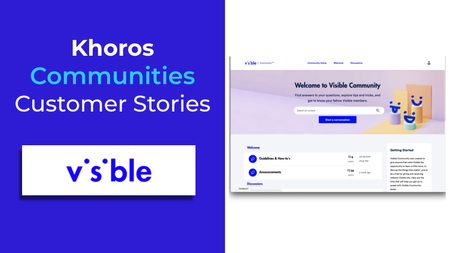
*This post is part of a new series highlighting communities both established, and brand new to the Khoros platform. Subscribe to the "Customer Stories” label to be notified when a new post is added to this series.* The following responses were provided by Michelle Ferrall, Principal Product Manager at Visible: Please share a bit of history/background about the Visible Community. We wanted a place for our members to connect with each other. We have groups on other social platforms but didn’t have our own hosted community until we launched with Khoros. One of our top product features is Party Pay, where members can link up with others to get a discount on their wireless service. The Visible Community provides a place within our website for members to join together and get a discount. Why did you choose to launch on the Khoros Community platform? Visible wanted to build a platform that could quickly grow and adapt as we expand our business offerings. We needed something that could be stood up quickly. What was most important to you and your Community team during the launch project? Meeting our launch deadline - we launched the Community in less than one month. What’s next? We’re looking at creating groups to support various initiatives, utilizing the events capability, and getting feedback from members on our product offerings. Goals: Divert care volume Grow Visible member base Foster connections between members Get product feedback from members Community features live today: Forums Blog Ranks Badges Leaderboards Visible Community Team: Michelle Ferrall, Principal Product Manager and Community Manager Kirsten Williams, Business Operations Analyst and Moderation Manager Khoros Team & Contributors: Launch Project Manager: Chris Mayes Senior Community Strategist: Jenny Weigle Senior Front End Developer: Jesse Keyes Front End Developer: Jeanine Schoessler Application Engineer: Thomas Su Customer Success Director: Michelle Ziadie Customer Account Executive: Ken Ban Technical Account Manager: Kaleena Perkins Atlas users, please take a moment to check out the Visible Community! Reply and let us know what you like best about it!831ViewsSign in to react to this post0CommentsAnnouncing the 2021 Khoros Kudos Awards
Does your brand use Khoros technology to deliver world-class digital customer experiences? Do our tools help you build strategies and results that others can learn from? Share your stories and successes through the second annual Khoros Kudos Awards in one of these 12 categories: Best-in-Class Care Best-in-Class Community Best-in-Class CX Insights Best-in-Class Marketing The Accelerator All-Ways Connected Better Together: Customer Engagement Bottom Line Savings Rock Star Keep Calm and Carry On Rookie of the Year Small But Mighty Top Line Growth All Star We’ll announce the winners on Atlas and Khoros social media channels. Throughout our virtual Khoros Engage conference in September, we will share all award submissions with our 1500+ attendees. We will invite winners to submit a short video describing their success that will be highlighted at the conference! Submissions are open until May 28, and more information about the Khoros Kudos Awards can be found on the contest page on Atlas. Check out our winners and finalists from last year for inspiration for your own submission! We look forward to celebrating your successes with you!7.5KViewsSign in to react to this post0Comments