Recent Discussions

Create project error. - Invalid response from server. Check your server url and version.
I have had this working before but now I am getting this message: MACOS Tahoe 26.2 (25C56) Using Node 6.11.2, also tried 10.24.1. Install Guld install sdk Try to create project - I receive the following after putting in token [14:04:11] got an error when trying to make the call: null [14:04:11] Invalid response from server. Check your server url and version. /Users/natalietrahan/.nvm/versions/node/v6.11.2/lib/node_modules/lithium-sdk/lib/version-check.js:79 throw error; ^ Error: Invalid response from server. Check your server url and version. at parseResponse (/Users/natalietrahan/.nvm/versions/node/v6.11.2/lib/node_modules/lithium-sdk/lib/version-check.js:96:13) at Request._callback (/Users/natalietrahan/.nvm/versions/node/v6.11.2/lib/node_modules/lithium-sdk/lib/version-check.js:33:15) at Request.self.callback (/Users/natalietrahan/.nvm/versions/node/v6.11.2/lib/node_modules/lithium-sdk/node_modules/request/request.js:199:22) at emitTwo (events.js:106:13) at Request.emit (events.js:191:7) at Request.<anonymous> (/Users/natalietrahan/.nvm/versions/node/v6.11.2/lib/node_modules/lithium-sdk/node_modules/request/request.js:1160:14) at emitOne (events.js:101:20) at Request.emit (events.js:188:7) at IncomingMessage.<anonymous> (/Users/natalietrahan/.nvm/versions/node/v6.11.2/lib/node_modules/lithium-sdk/node_modules/request/request.js:1111:12) at emitNone (events.js:91:20) 69ViewsSign in to react to this post
 1Comment
Classic: How to delete a board under grouphub using board delete v2 API
I am trying to delete a board under a Group Hub using the Board Delete v2 API: DELETE /api/2.0/boards/{board_id} However, I am receiving a 403 Permission Denied error, even though I am making the API call using a system user with Administrator permissions. Response: { "status": "error", "message": "Permission Denied", "data": { "type": "error_data", "code": 414, "developer_message": "", "more_info": "" }, "metadata": {} } Could you please let me know if there are any additional permissions or prerequisites required to delete a board under a Group Hub using this API?117ViewsSign in to react to this post3Comments
How to create/subscribe the Webhook in Aurora
Hello Folks, I would like to understand the steps involved in setting up a webhook, including how to create one and subscribe to it for specific events or actions. Any guidance or best practices for managing webhooks in Aurora would be greatly appreciated. Thanks in Advance.718ViewsSign in to react to this post6Comments
Help identifying XML fields for message attributes in Khoros data export
I'm working on a project where I need to parse and process a Khoros XML data export of my community, and I'm trying to map out the right entities and fields for several message-level attributes. Specifically, I'm trying to figure out which XML files, entities, and fields correspond to the following: Visibility scope of a message i.e how can I tell a message is private, draft or archived Whether the message is a solution and solution is marked by which user / user_id and when (time) Whether the message is read only or has comments blocked Moderation status - whether the message was rejected, approved etc Kudos - How can I find the kudos count and individual kudo for a message e.g user, time and weight info similarly, where is the MeToo data stored for a message? Any help with field names, entity references, look in would be a huge help.120ViewsSign in to react to this post1CommentHelp identifying XML fields for message attributes in Khoros data export
I'm working on a project where I need to parse and process a Khoros XML data export of my community, and I'm trying to map out the right entities and fields for several message-level attributes. Specifically, I'm trying to figure out which XML files, entities, and fields correspond to the following: Visibility scope of a message i.e how can I tell a message is private, draft or archived (API Reference) Whether the message is a solution and solution is marked by which user / user_id and when (time) (API Reference) Whether the message is read only or has comments blocked (API Reference) Moderation status - whether the message was rejected, approved etc (API Reference) Kudos - How can I find the kudos count and individual kudo for a message e.g user, time and weight info (API Reference) similarly, where is the MeToo data stored for a message? (API Reference) Any help with field names, entity references, look in would be a huge help.33ViewsSign in to react to this post0CommentsWhich entity to refer for knowing user to badge mapping in XML data dump
I'm working with XML data dump of my community and I'm able to access users and badge data individually. However, I'm unable to parse user to badge mapping i.e what all badges a specific user has been assigned Which entity or relation I should look for in the XML data dump to get that mapping or help me with any XML data dump related documentation if any108ViewsSign in to react to this post1CommentHow to parse <li-answer> <li-table> custom li tags into raw html
I was playing around with XML data dump of messages, and found custom HTML tags (<li-{type}> in the message content. From Khoros API (LiQL), I'm getting transformed HTML content, without any custom lithium HTML tags Tags example - li-answer, li-code, li-emoji, li-code, li-video, li-image etc How to parse such tags, and get content HTML like it is provided in the API using LiQL ?121ViewsSign in to react to this post1CommentHow to determine if a given node is visible to the public?
Hello! I am trying to figure out if it's possible, via API, to determine if a given node is visible to the public. E.g. is the "read posts" permission granted by default on that node. (which I suppose isn't a FULL check of the whole permissions tree but probably adequate for our needs) I've found that the roles collection will give you the list of roles for the node (https://developer.khoros.com/khoroscommunitydevdocs/docs/role-api-support#roles-collection-constraint-combinations ) - but that isn't actually helpful for figuring out what the permissions are, especially the DEFAULT permissions. I've also found the coreNode.permissions.hasPermission (https://developer.khoros.com/khoroscommunitydevdocs/reference/permissionshaspermissionpermission_identifier) call - but I think this can only be used to check if the user in context has a specific permission, not whether or not a node has a certain default permission. (I'm not actually a developer / won't be the one developing this, just trying to determine if a specific enhancement request is possible :-)) Thanks!!Solved1.7KViewsSign in to react to this post6CommentscoreNode.permissions.hasPermission context object probably is the closest you can get. But it's rather limited as you can only check for the current user AND current node. E.g. you cannot use it easily in a navigation component to show/hide elements without reading permissions.
I'm wondering what you are trying to build though that wouldn't work with Khoros built-in permissioning? The API is quite good at hiding stuff where the current user doesn't have read permissions. Isn't that sufficient for your use case?
Sign in to react to this post
Subscriptions to a label?
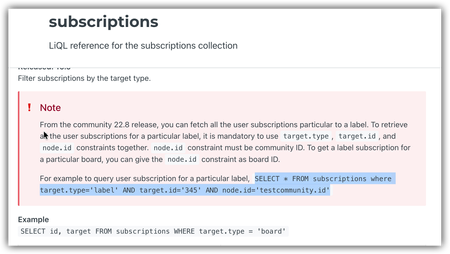
Hi all, I'm attempting to get the list of people who have subscribed to a label, but am struggling. The documentation is a bit confusing: It says both that you have to use a community ID as the node.id constraint but also that you can give the node.id constraint as a board id? Seems conflicting. And, regardless of the documentation, I get an error when I try to use a board ID (such as node.id='board:wireless-lan' where wireless-lan is the id of the board) My user has full admin permissions. Any ideas? I am not really a developer (as is probably evident!), just trying to pull a few bits of data for a stakeholder. Thanks!Solved2.7KViewsSign in to react to this post9CommentsI have been playing around for half an hour now and also only get subscriptions for the current user :( The target.id param seems to be always causing an error and therefor going against how it's documented even though it is returned in the resultset.
Sign in to react to this post

liqlAdmin in khoros aurora graphql API
Hi Folks, I want to add roles to the users using graphQL API given below. const ADD_USER_ROLE_MUTATION = gql` mutation addUsersToRole($roleKey: RoleKeyInput!, $users: [UserIdInput!]!) { addUsersToRole(roleKey: $roleKey, users: $users) { result { id name } } } `; const [addUserRole] = useMutation(ADD_USER_ROLE_MUTATION); addUserRole({ variables: { roleKey: { roleName: "role" }, users: [{ id: userId }] } }); The issue I am facing is that when this mutation is executed by an Admin user, the role is successfully added to the target user. However, when the same mutation is executed by a normal user, it fails to add the role due to permission denied errors. Is there a parameter or keyword that can be used in this mutation to allow a normal user to update their own roles or self-related data? For example, in Khoros Classic, we can use the liqlAdmin keyword in REST API requests to bypass such permissions. Is there an equivalent for GraphQL in Khoros Aurora? Thanks in Advance.Solved2.6KViewsSign in to react to this post13Comments- saikumarn1 year agoAdvisor
yogeshdixitChange the package name to "@customer/catfact-endpoint". If it still doesn’t work then request the Khoros support team to restart the community.
Sign in to react to this post